The contribution
of the Native American population to the history of collegiate and
pro football is generally summed up in most Americans minds in two
words: Jim Thorpe. This larger than life figure is undoubtedly one
of the greatest sports icons in American history. Babe Ruth, Jesse
Owens and Jim Thorpe take their place among modern phenoms such as
Michael Jordan and Muhammad Ali as the 20th Century’s
sports legends. But, to truly understand Thorpe’s greatness is to
understand the life of the man and the society that spawned him. To
understand the greatness of the Native American football programs
that contributed so mightily to the history of the sport is to
understand the institutions that spawned them.
This page will
examine three hallowed football programs which were comprised of
Native Americans. To tell these stories without expressing the
reality of life at that time is to deny the truth and to slight the
protagonists. In order to celebrate the victories on the field, we
must understand the hardships which existed in everyday life off it.
First, the story of the Carlisle Indian School of Pennsylvania
provides the background material necessary to begin to understand
the social and political climate that existed at the time of the
emergence of these programs. I have chosen to utilize the writings
and research of some true experts in this area historical study.
Contents
1. Introduction: The Reality of in the
Indian Schools, On Sacred Ground
2. Carlisle and the 1912 season
3. Haskell and the 1926 Season
4. Oorang
Indians
On Sacred Ground
Commemorating Survival and Loss at the Carlisle Indian School
by Stephanie Anderson
As published in Central PA Magazine, May 2000
In the middle of a bitter night in October 1879, a train puffed
slowly across the last few feet of track and eased into Carlisle
after a long journey from Dakota Territory. On board were 82
children from the Lakota people, whom most European Americans knew
as the Sioux. Hungry and tired, they rose from their seats one by
one, pulled their blankets tighter around them and stepped onto the
small platform at the station. Their eyes, adjusting to the
darkness, met a sea of strangers staring back at them. Just three
years after the Battle of the Little Bighorn, hundreds of
townspeople gathered with necks craned to glimpse the "exotic"
Indian children from what was still regarded as the Wild West.
During the next 39 years, American Indian
children became a familiar sight in Carlisle. While their arrival
was little more than a curiosity to the townspeople, their departure
from their homes, families and way of life marked momentous change
in the lives of the children, their parents and their tribes.
From 1879 to 1918, approximately 12,000 Native-American children
attended the Carlisle Indian Industrial School, on the grounds of
Carlisle Barracks, to become educated in the ways of
European-American culture. They came from all corners of the United
States - some even from Puerto Rico and the Philippines - and from
more than 140 tribes. Some came willingly; others did not. And while
many survived, some did not.
The goal of the Carlisle school and its
founder, a U.S. Army officer named Richard Henry Pratt, was total
assimilation of Native Americans into white culture, at the
deliberate cost of their Indianness. The legacy of Carlisle, and of
the extensive system of boarding schools it spawned, continues to
pervade the lives of Native Americans today. Mention the Carlisle
Indian School in Central PA, and most residents think of Jim Thorpe,
its most famous student. Proclaimed the world's greatest athlete,
Thorpe became a source of pride for the school and the town. But to
most Indians, the mention of Carlisle elicits a conflicting mixture
of strong emotions - both positive and negative - involving the
dignity of
survival and the mourning of lost cultural identity.
More than 80 years after the school closed,
the Cumberland County 250th Anniversary Committee has invited each
of the 554 federally recognized American Indian tribes, along with
the nonnative community, to come together in Carlisle for the
first-ever commemoration of the school and its contradictory legacy.
Powwow 2000: Remembering Carlisle Indian School will take place on
Memorial Day weekend on the site of the former school. The
organizers hope "to provide awareness of Native-American Indian
cultures and the Carlisle Indian School history, and to remember and
honor the students who attended the school."
But there's also a deeper purpose to the
singing and dancing, the ceremonies and talks. Pulitzer
Prize-winning Native-American author N. Scott Momaday, the keynote
speaker for the event, hopes "it is a healing process. We are doing
real reverence to the children."
Captain Pratt's Dream
"Convert him in all ways but color into a
white man, and, in fact, the Indian would be exterminated, but
humanely, and as beneficiary of the greatest gift at the command of
the white man - his own civilization."
- Characterization of Carlisle Indian School founder R.H. Pratt's
philosophy by historian Robert H. Utley, 1979
The history of the Carlisle Indian School
is inextricably linked with its founder. R.H. Pratt, a US Army
captain, had commanded a unit of African-American soldiers and
Indian scouts in Dakota Territory for eight years following the
Civil War. Subscribing to the ideas of the "Indian reformers" of the
time - many of whom were Quakers and Christian missionaries - Pratt
believed the solution to the so-called "Indian problem" was not separation, which
was the function of the reservations, but assimilation.
Pratt believed the best way for Indians to be absorbed into
mainstream American society was to provide them with an education.
In 1875, Pratt was assigned to guard a group of Caddo, Southern
Cheyenne, Comanche and Kiowa prisoners at Fort Marion in St.
Augustine, Florida. He selected a group of these prisoners to test
his hypothesis about Indian education and sent them to the Hampton
Institute in Virginia, then a boarding school for black children.
The 17 students adapted so completely to European-American ways that
Pratt decided he wanted an all-Indian school of his own.
In 1879, the Army gave Pratt permission to
house his school on an old cavalry post in the small, rural town of
Carlisle, Pennsylvania. He traveled west to recruit his first
students from Rosebud and Pine Ridge, two Lakota reservations in
what is now South Dakota. In the meantime, two of Pratt's former
pupils from Hampton were recruiting Cheyenne and Kiowa children for
Pratt in the Southwest.
Meeting with well-known and influential Lakota chiefs and elders -
Spotted Tail at Rosebud and Red Cloud at Pine Ridge - Pratt argued
that had their people been able to understand English, they might
have prevented the loss of land and freedom that had occurred with
the institution of the reservation system, or at least understood
what was to come.
Though Red Cloud and Spotted Tail were
skeptical of Pratt's intentions, they believed their land and
resources inevitably would continue to be purloined by the white
men. Each chief sent 36 children with Pratt, including five of
Spotted Tail's own children and Red Cloud's grandson. According to
Pratt's account, 10 more were added to the group as it made its way
to the steamboat for the first leg of the journey.
Collective Wail
"In our culture, the only time we cut hair
is when we are in mourning or when someone has died in the immediate
family. We do this to show we are mourning the loss of a loved one."
- Sterling Hollow Horn (Lakota), Pine Ridge, South Dakota, 2000
As the train carrying the first group of
Lakota students made its way across the country, townspeople came to
every train station to gawk at the children wearing their blankets
and moccasins. To avoid this spectacle in Carlisle, Pratt routed the
train to a tiny depot several blocks from the main station on High
Street. His plan was foiled, and hundreds of cheering Carlisle
residents were waiting on the platform. When the travelers arrived
at the school, Pratt was enraged to find that the federal Bureau of
Indian Affairs had failed to send provisions, bedding or food. The
children were forced to sleep, hungry, on the floor in their
blankets.
Pratt immediately left to collect the
Cheyenne and Kiowa children, and his wife and the teachers took
charge of the first wave of assimilation. The process began with the
outward signs of Indian appearance - clothing and hair. Confused and
homesick, the Lakota children wept as their long hair was cut and
fell to the ground. On one of the first nights after the Lakota
children arrived, a collective wail rose up from their throats, its
wrenching sound echoing across the campus. What they did not yet
know was they were mourning the shearing of their cultural
identities.
Tools of Assimilation
"God helps those who help themselves."
- Slogan on the masthead of the Carlisle Indian Industrial School
newspaper
Because Pratt wanted his charges to learn
trades as well as academics, half of each day was devoted to
reading, writing and arithmetic, and the other half to trades, such
as blacksmithing and carpentry for the boys, sewing and laundry for
the girls. The entire system was shaped by Pratt's military past.
Boys dressed in uniforms, and girls wore Victorian-style dresses.
The students practiced marching and drilling and were given
military-style ranks.
One of the few original structures still
standing on the grounds is a haunting reminder of the school's
rigidity. Built in 1777 to store gunpowder, the guardhouse contained
four cells in which children were locked up, sometimes for up to a
week, for various indiscretions. Running away was a common offense.
In addition to their vocational and academic pursuits, the Indian
children also studied the humanities. Pictures in the students'
sketch books chart the progress of assimilation. When they first
arrived, children drew things they remembered from home, such as
buffalo hunts and warriors counting coup on horseback. In time, the
drawings evolved into representations of their new lives - including
images of farms and children with short hair wearing European-style
clothing.
Mohican composer Brent Michael Davids, who
is performing at Powwow 2000, has studied the use of music as a tool
of assimilation. Though the children came from backgrounds rich in
song, they had no concept of European approaches to music. "The
students sang songs at mealtimes in a four-part harmony," Davids
explains. "It was a completely different singing style. The hymns
they were forced to sing were the Western style, espousing the
values of being good Christians."
Nearly 120 members of Davids' Stockbridge
Mohican clan attended Carlisle. He learned about them while
composing music for a CD-ROM about the Indian School. "[Carlisle]
was a missing link for me," Davids says. "I knew they tried to kill
us, then herded us onto reservations, but I couldn't figure out how
we cut our hair and started wearing shoes."
Theater also was used to indoctrinate the
students in the customs of white America. Lynne Allen, an artist who
lives in Furlong, Pennsylvania, remembers finding a photograph of
her Lakota grandmother, Daphne Waggoner, performing in a
Thanksgiving play at Carlisle. "Indians dressed as Pilgrims and
Indians dressed as Indians," Allen says, laughing at the irony of
Native Americans portraying stereotypes of themselves.
Language Lost
"When you destroy a person's language, it
destroys their world view. They're left with only fragments. I speak
Spanish, and I speak English. When you think in Spanish, it's
totally different. When they leave the school and go back to the
reservation, they're still Indian, but not anymore."
- Jorge Estevez (Taino), participant coordinator, Museum of the
American Indian, New York, 2000
The destruction of native languages was one
of Pratt's main objectives. Children began English lessons as soon
as they arrived at Carlisle. Students were punished, sometimes
severely, if caught speaking their native languages, even in
private.
According to Tsianina Lomawaima, a
professor at the University of Arizona and author of a book about
the Chilocco Indian School in Oklahoma, Carlisle and other boarding
schools modeled after it didn't instantly eliminate native
languages. But because of their school experiences, many former
students decided not to teach these languages to their children.
Sterling Hollow Horn, 38, who works at KILI,
a Lakota-language radio station on the Pine Ridge Reservation, had
several relatives who attended Carlisle and has witnessed this in
his own community.
"They didn't let [the students] speak in
the old language," says Hollow Horn, a member of revered leader
Crazy Horse's band of the Lakota people. "They set a dangerous
precedent. I'm fluent in the Sioux language. Most people my age
don't speak the language. It's dying out. The whole spirituality and
way of thinking is intertwined with the language. That's all being
lost. Carlisle was the starting point for this."
In 1995, Ed Farnham, a major in the US
Army, learned he was being transferred from his base in Germany to
the Carlisle Barracks. Originally from upstate New York, Farnham was
excited he would be living closer to his family. When he called his
mother to tell her, she asked him, "Don't you know what that place
is?" Only then did he realize he would be living in the same
Carlisle that had been the subject of murmurings in his family.
Farnham's grandmother, Mamie Mt. Pleasant,
attended the Indian School for nearly a decade. A Tuscarora Indian,
she was 14 when she was sent to Carlisle. Mamie's older brother
Frank had been one of the school's star athletes in football and
track and field. When Mamie came to Carlisle in 1908, Frank was in
London as a member of the US Olympic track-and-field team, but was
unable to compete in the broad jump because of a torn knee ligament.
Before she graduated from Carlisle in 1917, Mamie learned to sew and
was rumored to have been courted by another Carlisle athlete - Jim
Thorpe.
Though he grew up across the street from
his grandmother on the Tuscarora reservation near Niagara Falls, New
York, Farnham was never taught the Tuscarora language. After Mamie
Mt. Pleasant returned to the reservation from Carlisle, the only
time she spoke Tuscarora was at night, praying
Christian prayers before bed.
'The Man on the Bandstand'
"Kill the Indian, save the man."
- R.H. Pratt, often-repeated catch phrase
Pratt wrote extensively and candidly about
his reasons for founding the Carlisle school. He referred to
relations between European and Native Americans in terms of the
"Indian problem" and compared it to a similarly widespread attitude
toward the "Negro problem." In 1890 he wrote to the Commissioner of
Indian Affairs, "If millions of black savages can become so
transformed and assimilated, and if, annually, hundreds of thousands
of emigrants from all lands can also become Anglicized,
Americanized, assimilated and absorbed through association, there is
but one plain duty resting upon us with regard to the Indians, and
that is to relieve them of their savagery and other alien qualities
by the same methods used to relieve the others."
Pratt may be considered a bigot by today's
standards, but his views of African Americans and Indians were
considered progressive 100 years ago. He and most people who
regarded themselves as advocates for Native Americans considered
Carlisle a "noble experiment." He believed that education was the
only way native people would survive - at a time when the survival
of Indians was a goal that a significant number of white Americans
did not support.
ratt was often referred to as "the man on
the bandstand." Located directly in the center of the school's
campus, the circular bandstand provided a view of the entire
grounds. But more than a pseudonym for Pratt, the constant reminder
that "the man on the bandstand" was watching represented the
all-encompassing, paternalistic way in which Pratt and the teachers,
ministers and matrons viewed themselves as the "saviors" of the
Indian children. The phrase was meant to make the children feel
secure and cared for. It also reminded them that they were under
constant surveillance.
Tsianina Lomawaima believes, in some ways,
Pratt was unusual for his era. "His commitment to those students as
individual human beings was unique," she says. "He really believed
in them. He fought for those kids. The part of Pratt that wasn't
unusual was that he didn't believe Indian culture would survive, or
should."
"There were kids who were Lakota, and there
were kids who were Wampanoag. At Carlisle, they became Indian."
- Barbara Landis, Carlisle Indian School biographer, 2000
The erosion of Native-American sovereignty
was swift and unrelenting. Propelled by a hunger for land, gold,
power and control, it swallowed up everything in its path, including
communities, languages and religions. No matter the Nez Perce were
distinct from the Navajo, the Seneca from the Seminole, the Coeur
D'Alene from the Crow. They were one in their difference.
Repercussions of the Carlisle Indian School
experience are still felt today, often in unsuspected ways. In
March, National Public Radio reported that Native Americans were the
most undercounted ethnic group in the US Census, in part because
older members of the "boarding-school generation" remember that when
they gave their names to government agents, they were "carted off
involuntarily."
Most of the 2 million Native Americans
living in this country have some sort of biological link to Carlisle
or one of the boarding schools created in its wake. There is also a
shared sense of inner conflict. It is difficult for many Indian
people to fully condemn or condone Carlisle. But they agree the
disintegration of Indian cultures and the arrogant racism toward
native people is horrific.
Much of the inner turmoil Carlisle has
spawned revolves around the question of what the lives of native
peoples would have been like without Carlisle and similar boarding
schools. Barbara Landis, who researches the Indian School for the
Cumberland County Historical Society, points out that the children's
lives were less than idyllic before they came to Carlisle.
"It was just about the end of the
treaty-making era," Landis explains. All the major battles between
Indians and the US military were over except for the massacre at
Wounded Knee, which would take place in 1890. But the children would
have had some memory of the wars, in which their parents and
grandparents had participated.
"The only place for Indians was in the
agency [reservation]," Landis says. "Emotionally, the structure of
their world changed with the agencies, the rations, a whole new way
of eating, not being able to hunt buffalo."
"Most people around here are proud their
children and ancestors went there," Sterling Hollow Horn says of the
Carlisle Indian School. "But four- and five-year-olds were being
taken from their families. There was a lot of confusion from
parents, but more so from the children. Carlisle was good, and it
was bad. It depends how you want to look at it. I personally think
it was good. It showed Indian kids were intelligent. But I know a
lot of people would disagree with me."
Ed Farnham has only begun to wrestle with
his feelings about Carlisle. "It's a touchy subject," he says. "On
the one hand, you had all these Indians coming together to play
football and being a dominating force. That was great, and that
never would have happened [otherwise]. But losing or suppressing
your cultural identity, that's not good.
"I know things would have been different if
my relatives hadn't come here. My grandmother wouldn't have been a
seamstress. My uncle wouldn't have gone to Europe and done all he
did."
Though her grandmother described her time
at Carlisle as pleasant, Lynne Allen feels boarding schools
contributed to her own confusion about cultural identity. Though
Allen is a descendant of Chief Sitting Bull, she is only
one-sixteenth Lakota - not enough to be officially recognized by the
tribe as a member.
"Being part Indian and not belonging
anywhere was something [my mother] carried with her her whole life,"
Allen explains. "It's something she passed on to me, this feeling of
being marginalized.
"Part of me knows it helped a lot of people
survive in the world. But there were people who stayed on the
reservations and survived, too. It was the age, it was the era of
missionaries and zealots trying to 'help the savages.' ... I don't
know what would've happened if they wouldn't have done that."
A Time For Healing
"My lands are where my people lie buried."
- Crazy Horse, Oglala Sioux leader, 1877
When you are driving on Claremont Road in
Carlisle, it's easy to miss the small, tidy cemetery along the side
of the road. The long, slender limbs of a weeping-cherry tree in the
nucleus of the plot reach down like fingers brushing along the
arched tops of pristine, white tombstones surrounded by a short,
iron fence. Row after neat row of graves dot the grass.
The Indian cemetery is one of few traces of
the school left in Carlisle. More than 175 tombstones line the
ground. Prayer cloths, strings of shells and beads and small bundles
of sage and sweetgrass embrace the tree trunk.
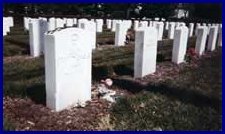 The realization is harsh and unforgiving -
there are children buried here. They died of the diseases that
killed many children in those years, regardless of ethnicity.
Climate change, separation anxiety and lack of immunity also
contributed to the toll. Most were sent home for burial, but some
had no relatives who could have made the arrangements, or their
homes were simply too far away. Because of fear of infection,
tuberculosis victims were buried immediately. The realization is harsh and unforgiving -
there are children buried here. They died of the diseases that
killed many children in those years, regardless of ethnicity.
Climate change, separation anxiety and lack of immunity also
contributed to the toll. Most were sent home for burial, but some
had no relatives who could have made the arrangements, or their
homes were simply too far away. Because of fear of infection,
tuberculosis victims were buried immediately.
Most of the town of Carlisle's connection
to the school revolves around its legendary football team and Jim
Thorpe. In the All-American truck stop just outside of town, there's
a wall covered with framed photographs and newspaper clippings of
Thorpe. A memorial stone in the town's square pays tribute to him.
Wardecker's, a men's clothing store on Hanover Street, which at one
time extended a special line of credit to the Indian School's
athletes, houses a shrine of photographs of Thorpe, Coach "Pop"
Warner and the football team. Carlisle High School's mascot is a
buffalo, and its nickname is the Thundering Herd.
But Native-American memories of the
Carlisle Indian School run much deeper. Beverly Holland, who lives
in Harrisburg, moved to Central Pennsylvania about 20 years ago from
the Yankton Lakota reservation in South Dakota. Her grandfather
attended Carlisle for nearly four years. But, like Ed Farnham, she
didn't make the connection that she was living so close to the
former school.
"I didn't run right to the school after I
found out," she says. "It was a long time before I could visit the
cemetery. I think I visited there about four or five times before I
could stop crying."
It was equally moving for Farnham. "I had
no idea what happened there," he says. "I was ignorant."
But when he visited the grounds for the
first time as a soldier, he acknowledges a complete reversal of
attitude. "It was almost a spiritual event for me, once I understood
that's where my grandmother walked for so many years," he says. "She
was Christian. I know she would've gone to the chapel. The
foundation of the chapel was about 200 yards from where we were
housed. Kneeling on the ground [in the cemetery], looking at the
graves, you just have ... more of a reverential attitude."
Sacred Ground
Powwow 2000 will doubtless be an emotional
time, but the members of the organizing committee, comprised of
about half native and half nonnative members, hope the event will
help salve the unrelenting pain felt by so many.
Nadine West, a Chippewa Indian and member
of the powwow committee, has made an annual pilgrimage from her home
in Harrisburg to the Indian cemetery each Memorial Day for years.
She claims the decision to schedule the powwow during a national
holiday of remembrance was deliberate and symbolic. "Those children
in that cemetery are our veterans," she says.
Originally from the Cheyenne River Lakota
reservation in South Dakota, Carolyn Rittenhouse of Lancaster joined
the powwow committee after realizing the impact of the school on
Lakota children. They were the first students to attend the school,
and more than 1,100 of them went to Carlisle throughout its tenure,
including her great-uncle, Thomas Hawk Eagle. Four generations
removed from Carlisle, Rittenhouse's daughter Danielle, 9, plans to
dance the jingle-dress dance at the powwow.
Rittenhouse believes the powwow also will be a positive experience
for non-Indians. "The nonnative community will be educated when they
attend - seeing the dancing, eating the food, hearing the stories -
so healing can begin for them, as well," she claims. "The event
won't only impact native people, but the whole community."
Since the closing of the Carlisle Indian
School, the descendants of its students and the descendants of the
community into which they were to be assimilated have never come
together to consciously honor he students' memory. It is significant
that when they do so this month, the commemoration will take place
on the ground where the tears of those first Lakota children fell
121 years ago.
"I hope that everybody there has a sense of
the sacrifice that the children made," says keynote speaker N. Scott
Momaday. "Sacrifice is related to the word 'sacred.' It is a sacred
place because of the sacrifice made by the children."
Stephanie Anderson is the managing editor
at Central PA Magazine in Harrisburg, Pennsylvania.
RETURN TO TOP OF PAGE
Carlisle and the Season of
1912
Carlisle founder, William Henry Pratt, was
intrigued by football, but was wary of how his students would be
perceived if they competed directly with whites. In the first
football game at Carlisle, a student broke his leg and Pratt
disbanded the program. But in 1893, at the behest of more than
thirty young students, he relented, and Carlisle Indian Football was
reborn, and continued for the next 24 years.
Legendary coach, Glenn “Pop” Warner arrived
at Carlisle in 1899. Warner had coached at Georgia and Cornell. He
coached at Carlisle for two years before returning to Cornell for
three seasons. He returned to Carlisle in 1907 and transformed the
team into a national football power. During his two stints at
Carlisle, he posted a record of 108 wins, 41 losses, and 8 ties
against major college opponents over a fifteen year period. He
emphasized a systematic, team-oriented approach to the game and was
blessed with several outstanding talents at Carlisle.
Jim Thorpe (Wa-Tho-Huk) is America’s sports
legend, generally regarded as our greatest athlete in history. Most
American sports fans know the story of his Olympian achievements.
One of the greatest figures in Olympic history, alongside Jesse
Owens, his importance to Olympic history has been likened to that of
Coroebus of Elis, the first man to win a recorded Olympic race in
the year 776 BCE. Thorpe was stripped of his medals due to questions
regarding his amateur status, but these were reinstated
posthumously.

Jim Thorpe (left) and Glenn "Pop" Warner
(right).
Jim Thorpe was born on May 28, 1887 in Oklahoma. He had a twin
brother named Charlie. Jim and Charlie went to school in Stroud,
Oklahoma at the Sac and Fox Indian Agency School. Charlie died when
the boys were eight years old and Thorpe fought depression in the
aftermath. His parents sent him to Haskell Indian Institute in
Lawrence, Kansas where he was introduced to sports. His mother died
while he was at Haskell and, in 1904 at age fifteen, Thorpe went to
Carlisle Indian School in Pennsylvania. After he had been at
Carlisle for two months, his father died. At Carlisle Jim met "Pop"
Warner who would help begin his great athletic career. Warner's
innovations made Thorpe a triple threat, a weapon who could run,
pass, and kick with equal devastation.
Thorpe gained nationwide attention for the first time in 1911. He
was a football consensus All-American in 1911 and 1912. He played in
multiple roles for Carlisle: as a running back, defensive back,
place-kicker, and punter. The Indians went 11-1 in 1911 with a 18-13
upset of Harvard, in which Thorpe scored all of his team’s points.
In 1912, he led Carlisle to the national championship, scoring 25
touchdowns and 198 points in 12 games. The crowning achievement of
the ’12 season was an upset of mighty Army at West Point. He was 25
in 1912 and besides his football accomplishments, competed for the
US team at the Stockholm Olympic Games. He won Gold in both the
decathlon and the pentathlon events. Following the triumphs of 1912,
Thorpe went on to play major league baseball. For six years he
played for the New York Giants, from there he spent a short time
playing in the outfield for Cincinnati. He played professional
football with the Canton Bulldogs, Oorang Indians, and four other
professional teams. Incredibly, he also played pro basketball,
barnstorming with "Jim Thorpe and His World-Famous Indians" in 1927
and 1928.
What most Americans don’t know about Thorpe’s early
years makes his story all the more incredible. The
Carlisle Indian School, like other government
established facilities, was an acculturation facility.
In the early years of its existence, the school was
populated with children who were forcibly removed from
their families. It was often an anguishing experience.
It is now known that the Institute was typified by a
military atmosphere of intolerance and rigidity.
Evidence of mental and sexual abuse are investigated by
historians. The children were forced to “Americanize”.
They were told they were being “civilized” and “raised
up” from an inferior way of life. Those who resisted
change were called “bad Indians”. Likewise, those who
assimilated quickly were classified as “good Indians.”
Thorpe arrived at Carlisle in confusion and under great stress from his personal life, having lost
all of his family members. He was orphaned shortly after his arrival
in Pennsylvania.
|
 |
THORPE'S INDIANS CRUSH WEST POINT
Brilliancy of Carlisle Redskins'
Play Amazes Cadets and Spectators.
|
 |
SHOW SPEED AND ACCURACY
Thorpe Plows Through Army Line and Cadets Are Unable to Check Him-
Arcasa a Fine Running Mate.
Special to the New York Times
WEST POINT, Nov. 9- Jim Thorpe and his redoubtable band of Carlisle
Indian gridiron stars invaded the plains this afternoon to match
their prowess against the moleskin gladiators of Uncle Sam's
Military Academy, and when the two teams crossed the parade ground
in the semi-darkness of late afternoon the Cadets had been shown up
as no other West Point team has been in many years. They were buried
under the overwhelming score of 27 to 6, figures that no other team
has been able to reach against the Cadets since West Point loomed up
among the big football teams, and to make the defeat all the more
humiliating every Cadet who had played or had merely looked on knew
deep in his heart that this big score did not show the relative
strength of the two teams, based on today's performances.
It was a game such as the old reservation has seldom, if ever,
staged. In a way it carried a distinct shock to the 3,000 spectators
who had firmly believed that the big Army team had passed the stage
where such a thing might happen. But the unexpected did happen, and
its materialization was effected with an exhibition of football by
the wards of the Nation that distinctly places the Carlisle team
among the great elevens of the year. The Indians simply outclassed
the Cadets as they might be expected to outclass a prep school. They
played football that won by its steadiness rather than novel
formations. Speed and accuracy marked every move of the redskins,
and they showed that football can still be spectacular while the
so-called old style methods are employed most of the time.
Standing out resplendent in a galaxy of Indian stars was Jim Thorpe,
recently crowned the athletic marvel of the age. The big Indian
Captain added more lustre to his already brilliant record, and at
times the game itself was almost forgotten while the spectators
gazed on Thorpe, the individual, to wonder at his prowess. To
recount his notable performances in the complete overthrow of the
Cadets would leave little space for other notable points of the
conflict. He simply ran wild, while the Cadets tried in vain to stop
his progress. It was like trying to clutch a shadow. He did not make
any of the four touchdowns credited to his team, simply because the
brilliant Arcasa, Thorpe's backfield mate, was chosen to carry the
ball on three of the four occasions when a plunge meant a score. But
failing to score and failing to shine are totally different.
Thorpe went through the West Point line as if it was an open door;
his defensive play was on a par with his attack, and his every move
was that of a past master. In the second half the game was delayed
for three minutes because of an injury to Thorpe's left shoulder-
the recurrence of an injury which had come back twice in previous
games- and for a time it seemed that the great Indian must leave the
game. For a full minute he lay prone, on the field; then he was
helped to his feet and first aid was applied. When Thorpe walked
back to his position behind the line the crowd gave him an ovation
that was remarkable, in view of the fact that he was the one big
obstacle between West Point and victory. And it was a crowd made up
almost entirely of West Point sympathizers.
Thorpe tore off runs of 10 yards or more so often that they became
common, and an advance of less than that figure seemed a wasted
effort. His zigzag running and ability to hurl himself free of
tacklers made his running highly spectacular. In the third period he
made a run which, while it failed to bring anything in points, will
go down in the Army gridiron annals as one of the greatest ever seen
on the plains. The Indians had been held for downs on West Point's
3-yard line, and Keyes dropped back behind his own goal line and
punted out. The ball went directly to Thorpe, who stood on the
Army's 45-yard line, about half way between the two side lines. It
was a high kick, and the Cadets were already gathering around the
big Indian when he clutched the falling pigskin in his arms. His
catch and his start were but one motion. In and out, zigzagging-
first to one side and then to the other- while a flying Cadet went
hurling through space. Thorpe wormed his way through the entire Army
team. Every Cadet in the game had his chance, and every one of them
failed. It was not the usual spectacle of the man with the ball
outdistancing his opponents by circling them. It was a dodging game
in which Thorpe matched himself against an entire team and proved
the master. Lines drawn parallel and fifteen feet apart would
include all the ground that Thorpe covered on the triumphant dash
through an entire team.
West Point's much talked of defense, which had held Yale to four
first downs in a full hour of play, was like tissue paper before the
Indians. To a corresponding degree the Indian defense, which had
been considered so much inferior to their attack, was a wonder. The
Cadets got one first down in the first period and in the second,
when they showed their only bit of rushing ability, they got four,
three of these coming just before the touchdown was made. In the
second half, West Point did not make a first down. In fact, barring
the second period, the Cadets spent all their time on the defense.
They got the ball occasionally, but only to make the futile advances
and then punt.
From a Carlisle standpoint the game was simply one first down after
another. In midfield the redskins ran wild, but the Army had the
habit of tightening up when the goal line was threatened, and four
times the Indians lost the ball after traveling to within the five
yard line. Twice the loss came on downs and twice forward passes
were tried on the final down. The Indians got away four passes that
were very cleverly executed, and these gained considerable ground.
The Cadets tried the forward pass a few times and it failed every
time.
Roughness marred the game to such an extent
that two of the best players in the game were relegated to the side
lines for uncalled-for roughness. In the first period Powell, the
Indian fullback, was sent off the field for a mix-up with Herrick of
the Army team, and in the second half Capt. Devore of the Cadets
drew a similar penalty for an encounter with Vederneck. The Indians
lost twenty-seven yards with Powell's disqualification, and the
Cadets lost fifteen when Devore was sent out.
Arcasa and Guyan ranked next to Thorpe in the honors of the
afternoon. Arcasa starred as a ground gainer, and he teamed with
Thorpe in an exemplification of the old-time criss-cross which
seldom failed to fool the Cadets.
The Indians lost seventy-five yards in penalties, and the Cadets
lost forty-five.
Carlisle won the toss and chose the north goal, being slightly
favored with the northwesterly wind, which was blowing very strong,
but rather across the field than at their backs when the game began.
Devore kicked off to Thorpe, who fumbled at the 10-yard line, but
recovered the ball and carried it to his 28-yard line before being
downed. On the first play the Indians gave a sample of what was to
come, Arcasa dashing around Hoge's end for a gain of fifteen yards,
which brought the ball to the 43-yard line. On a criss-cross play,
with Thorpe taking the ball from Arcasa, the great athlete galloped
around the Army's right end for fifteen more yards and another first
down at West Point's 42-yard line. Arcasa failed to gain, Powell hit
the centre for seven yards, and then the criss-cross again fooled
the Cadets, Thorpe making twenty yards and bringing the ball to the
Army's 15-yard line. Thorpe fumbled the ball as he was thrown hard
and it was recovered by Prichard where Thorpe fell.
Thorpe zigzagged his way through the yard line for a first down.
Arcasa and Powell picked off three yards apiece and brought the ball
to the 25-yard line, but the Indians were penalized fifteen yards
for holding and the ball went back to the Army's 40-yard line. Hobbs
broke through for a twenty-yard gain and planted the ball on
Carlisle's 36-yard line. Thorpe made a pretty tackle. Two rushes by
Keyes and one by Hobbs made it first down on the 4-yard line, and on
the third try from this point Hobbs circled the Indians' right wing
for a touchdown. Prichard failed to kick an easy goal.
This about finished the Cadets. After Devore kicked off the Indians
were forced to punt, but the Cadets could not gain and, being
handicapped more by a fifteen-yard penalty, Hobbs punted to Arcasa,
who made a fair catch on West Point's 44-yard line. On another criss¬-cross
from Arcasa to Thorpe the latter got seventeen yards, two rushes by
Arcasa netted four yards and another criss-cross brought the ball to
within six yards of the Army goal line. On the first rush Bergie
went over for a touchdown and Thorpe kicked an easy goal, putting
the Indians ahead, 7 to 6.

Shortly after the second half began Captain Devore of the Army was
ruled out of the game for rough work against Gujan, and West Point
lost fifteen yards, half the distance to her goal line. The Cadets
could not gain and Hobbs punted to Arcasa at the Indians' 43-yard
line. From this point the Indians began a steady advance to the Army
goal line, with Thorpe and Arcasa starring, but were halted on downs
inside the 5-yard line.
This paved the way for the most spectacular play of the game.
Standing behind his own goal line, Keyes kicked to Thorpe at the
45-yard line, and the speedy Indian wormed his way through the
entire Army team for a touchdown, and the ball went the Army at
their 22-yard line. Three successive rushes by Arcasa made another
first down on the Army's 25-yard line. Thorpe carried the ball to
the 10-yard line for another first down. Two rushes by Powell and
Arcasa netted only five yards, for once the criss-cross failed to
gain, and Thorpe tried a forward pass to Arcasa. On the first
line-up Thorpe made a wonderful punt of fifty-five yards, the ball
going, scarcely more than fifteen feet in the air. The Army on their
first rush got their second first down of the game. Eisenhower
carrying the ball twelve yards to his own 47-yard line. Powell and
Herrick engaged in a scuffle on this play, and the Indian full back
was ruled out of the game, his team drawing a penalty of
twenty-seven yards, or half the distance to their goal line. The
Indians tore the Army line to pieces in their steady advance, and in
seven rushes sent Arcasa over for another touchdown. Thorpe kicked
the goal. Score: Carlisle. 14: West Point, 6.
Keyes kicked to Arcasa, who was downed at his own 25-yard line, and
then began another advance which ended in another touchdown by
Arcasa and another goal by Thorpe. The Indians did not lose the ball
during the journey of seventy-five yards.
Early in the final period the Cadets held the Indians, and Thorpe
tried for a goal from placement from the 44-yard line after a
15-yard penalty. The kick was true, but the ball fell short. Keyes,
was quickly forced to punt, and Thorpe got the ball at midfield.
From this point the Indians made another advance toward a touchdown,
but lost the ball on downs on the one-yard line. Coffin, who had
succeeded Keyes, punted from behind his goal line, but the ball hit
one of the goal post uprights and was recovered by the Indians on
West Point's 12-yard line. On the fourth try Arcasa went over for a
touchdown, and Thorpe failed to kick the goal. The game ended a few
seconds after Coffin had again kicked to the Indians.
Note:
A frequently quoted anecdote from the Carlisle-Army game has become
legendary. During the game, future President Dwight Eisenhower
injured his knee while trying to tackle Thorpe. Thorpe’s performance
that afternoon was so dominating that Eisenhower, together with a
conspirator, Charles Benedict, planned to take Thorpe out of the
game. Although they succeeded in briefly stopping a Thorpe-led drive
by using a double-tackle on the halfback, a deft maneuver by Thorpe
dodged them a play later and sent the two West Pointers crashing
headlong into each other. They were temporarily stunned and removed
from the game. Eisenhower remembered Thorpe in a 1961 speech, "Here
and there, there are some people who are supremely endowed. My
memory goes back to Jim Thorpe. He never practiced in his life, and
he could do anything better than any other football player I ever
saw."
It is one of the true ironies of American sports history that Warner
and Thorpe arrived at Carlisle at the same time. The two great men
crossed paths and forever changed collegiate football history.
During the four years that Thorpe played for Warner at Carlisle, the
team won 43 games, lost 5 and tied 2. Included in the list of
defeated powerhouses were Penn State, Syracuse, Army, Navy,
Minnesota, Nebraska, Chicago (under Amos Alonzo Stagg), Princeton,
Harvard, and Villanova.
The 1912 team is the one that will always be remembered for bringing
the national championship to the tiny Indian school. Carlisle was
closed in 1918 and the memory of the football program has faded
away. But, for a generation of Americans, this was one of the finest
collegiate teams that ever played the game, superbly coached and led
by the greatest star in the history of American sports.
RETURN TO TOP OF PAGE
Haskell and the Season of
1926

Haskell Indian Nation University of
Lawrence, KS was
founded as the United States Indian Industrial Training School in
1884 as an agricultural educational primary school serving American
Indian children. Boys were taught trades and girls studied
homemaking. Most of the students' food was produced on the Haskell
farm, and students were expected to participate in various
industrial duties. Ten years later, a "normal school" was added. By
1927, the high school classes were accredited by the state of
Kansas, and Haskell began offering post high school courses in a
variety of areas.
Part of Haskell's attraction was not only its post high school
curriculum but also its success in athletics. Haskell football teams
in the early 1900's to the 1930's are legendary. And even after the
1930's, when the emphasis on football began to decrease, athletics
remained a high priority to Haskell students and alumni. Today,
Haskell continues to pay tribute to great athletes by serving as the
home of the American Indian Athletic Hall of Fame.
The Carlisle Indian School of Pennsylvania had represented football
at the government’s Indian schools since the 1890s. The United
States Bureau of Indian Affairs saw the attention to the football
programs as an excellent means of publicizing the efforts to educate
and assimilate the Native American race into mainstream white
culture. In the early part of the 20th Century, Haskell was
overshadowed by the reputation of Carlisle, which was recognized as
a major power in college football in the early 1900’s. In the
absence of professional football, Carlisle had been considered world
champions after their magnificent campaign of 1912.
In 1904, Haskell and Carlisle met when promoters of the St. Louis
World's Fair concluded that a
Haskell-Carlisle game at the fair
would be an incredible spectacle. The game was scheduled for the
Saturday after Thanksgiving, which fell on November 26. Carlisle won
easily, 38-4. "Pop" Warner's team left the fans thinking that
Eastern football was superior to that played in the Midwest. But,
Carlisle closed in 1918, and the nation’s attention shifted to
Haskell Indian Institute of Lawrence, Kansas.
Throughout the era of the 1920s Haskell football teams traveled from
coast-to-coast to meet national powerhouse programs. They were
the subject of continuous racial stereotyping by newspaper writers
and game promoters. Almost without exception, the predominantly
white crowds were treated to pregame and halftime activities that
usually entailed some type of Indian costumes and ceremonies.
Players were regularly expected to pose for publicity photos while
wearing outfits that included plenty of Indian feathers. Many
latter-day historians believe that football games against the
Haskell Indian teams came to actually represent a reenactment and
reaffirming of the frontier struggles of the past, which had
established white superiority over the Indian race.
From 1900 through 1930, Haskell defeated Kansas, Missouri, Texas,
Nebraska, Kansas State, Texas A&M, LSU, Oklahoma State, Tulsa, TCU,
Baylor and Michigan State. Coaches of national renown guided the
program. John Outland of Outland Trophy fame and an earlier rule
developer, coached at Haskell in 1906. In the early 30’s, William
“Lone Star” Dietz, a former teammate of Jim Thorpe and coached by
Glenn “Pop” Warner at Carlisle, took over the program. Dietz had led
Washington State to the first modern Rose Bowl in 1916 and is still
the only coach to lead the Cougars to a Rose Bowl victory. This
game, more than any other, is considered to have given Western
football respectability against the East. Also, Washington Redskins’
owner George Marshall re-named his team (formerly the Boston Braves)
the Washington Redskins in honor of Dietz. Dietz left Haskell
for the Washington head coaching position under Marshall in 1933.
And, former Haskell head coach, Matty Bell, coach from 1020-22, is a
member of the College Football Hall of Fame.

The Haskell
Indians of 1926
In 1922, Haskell hired Dick Hanley, former quarterback at Washington
State as the athletic director and coach of the football team. In
the seasons of 1922-25, Hanley had led the Haskell Indians to a
composite record of 33-9-3. Hanley moved the Haskell Indians into
inter-sectional schedules that saw them playing major teams from
around the country. And, in 1926, Haskell constructed its first
concrete modern stadium. Previously, few home games had ever been
played since there had been no grandstands and any fans had to
stand along the sidelines or sit in their cars.
The ‘26 team was comprised of nearly 50 players, representing
eighteen different tribes from all over the country. The team was
led by Captain Tom Stidham, at right tackle. His running mate at the
other tackle spot was the giant (245 lbs) Theodore "Tiny" Roebuck.
Hanley considered the two the finest tackles in the country. The
backfield was incredible with Egbert Ward at quarterback, along with
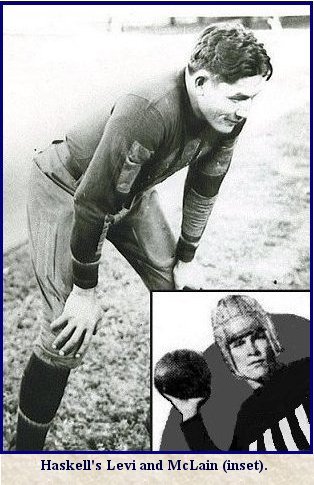
halfbacks George Levi and Elijah Smith. At fullback was Louis Colby.
On the second team backfield was a young Irish-Cherokee fullback
named Mayes McLain. Hanley felt that there was something special
about the six foot, 200 pound McClain. And, in 1926, Hanley would be
proven right.
The first game of the 1926 season was played at home in the new
stadium as Haskell buried Drury College of Springfield, MO, 65-0.
The second game saw Haskell defeat Wichita 57-0. The Wheatshockers
had only one scoring threat on the day. McLain scored all eight of
the Haskell touchdowns and kicked seven PAT's. In week three, the
Indians coasted to a 55-0 victory over Still College of Des Moines,
IA. The next week against Morningside College of Sioux City, IA. McLain scored four
touchdowns in Haskell's 38-0 win.

The Indians then headed to Dayton, which was first real test of the
season. The Dayton Daily News wrote that Haskell’s team was “anxious
to return to their native haunts in Kansas with the scalps of the
men of Dayton.” The largest crowd in Dayton history watched as their
team took a 7-0 lead on a blocked punt in the first period. But
later in the quarter Haskell responded with a 70 yard drive which
ended with McLain scoring the TD on a 4-yard plunge to tie it at
7-7. McLain would tally four touchdowns on the afternoon and add a
field goal as Haskell crushed Dayton, 30-14.
Back home the next week, Joe Cross scored four touchdowns and kicked
five PAT's and McLain added four TD's, as Haskell totaled 795 yards
of rushing offense on the way to a 95-0 win against Jackson College.
Haskell entered the power part of their schedule when they faced Bucknell in the first-ever homecoming
game played at Haskell. The media had a
great time writing about "redmen” and the Indian students posed with
head-dresses for the visitors and press. On the day of the game the
new stadium was formally dedicated and presented to Haskell
Institute by Senator Charles Curtis of Kansas, Senate Majority
Leader, future Vice President and Kansa-Kaw Indian.
The game itself was no contest as Haskell dominated in a 36-0 win
over shocked Bucknell. For the day, McLain had tacked on two
touchdowns and rushed for 129 yards in 27 tries. Smith had rushed
for 140 yards in 17 tries as Haskell piled up 521 yards of total
offense.
The Kansas City Star noted that the win "sent the crowd of Braves
back to their tepees to narrate the deeds of valor done by their
offspring upon the modern battle ground... Watching the Redskins
smash into the White Man makes one glad America was Americanized
before the Football Era."
The following week, the Indians took on Loyola of Chicago at
Muehlebach Field in Kansas City. They trailed early, 7-0, after
Loyola scored on 58 yard touchdown pass. McLain suffered a knee injury in
the second quarter, but Louis Colby scored three touchdowns and
Haskell won, 27-7.
The Indians next traveled to Boston to meet the unbeaten Eagles of
Boston College who were considered a power in the East that season.
McClain would not play due to his knee injury from the previous
week. More than 20,000 spectators jammed Braves Field (home of the
Boston Braves of baseball). BC scored early on a 50 yard interception return. In
the second quarter, Elijah Smith fumbled a punt on his own 17 and
the Eagles scored in four plays for a 14-0 lead. On the last play of the
half, Haskell attempted a drop-kick from their 47, but it hit the
crossbar and kept the Indians scoreless.
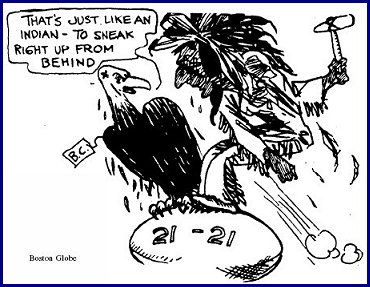 Boston came out aggressively in the third quarter. BC blocked a punt
into the endzone and recovered it for a 21-0 lead. From that point,
Haskell’s offense started to take over and, on an eight play drive,
Louis Colby scored to the Indians to within 21-7 at the end of the
quarter. Boston came out aggressively in the third quarter. BC blocked a punt
into the endzone and recovered it for a 21-0 lead. From that point,
Haskell’s offense started to take over and, on an eight play drive,
Louis Colby scored to the Indians to within 21-7 at the end of the
quarter.
In the fourth quarter, the Indians marched 76 yards in 14 plays and
Colby scored from the three to make it 21-14. A short time later,
Haskell recovered a BC fumble at the Eagles’ 15 yard line. Colby
went in on a ten yard carry and the score was tied, 21-21. The
comeback in Boston against a powerhouse program was phenomenal.
Especially considering that their leading rusher did not play. The
Boston College Eagles finished the 1926 season undefeated at 6-0-2.
Hanley then led his team to Lansing, Michigan to take on Michigan
State in a game played on a snow-covered field with McLain again
seeing no action. Haskell cruised to a 40-7 victory. Next up was a
trip to Cincinnati for a Thanksgiving Day game with unbeaten Xavier
(9-0),which was experiencing the finest season in their history.
During the week before the game there were numerous rumors
circulating about the possibility of an end-of-season game between
Haskell and Notre Dame, but this was never pursued because of the
expected financial guarantees that Notre Dame would require (Haskell
was 0-4 against Notre Dame from 1914-1932).
The Cincinnati Enquirer described the game as a “modernized version
of warfare between the paleface and the proud representatives of the
Indian empire of the past". McLain was back for this one and he
scored three touchdowns and Colby another, as Xavier was throttled,
27-0.
The Braves returned home at last on Nov 27. Coach Hanley confirmed
that he had accepted an offer to become head coach at Northwestern.
Also, it was announced that the team had declined an invitation to
travel to Honolulu for games with Hawaii U on Christmas Day and an
All-Star squad on New Years Day. The players were exhausted.
On Dec 4, Haskell traveled to Oklahoma to meet Tulsa, which featured
a wide open aerial attack. The Hurricanes had defeated the Valley
champs (precursor to today’s Big 12), Oklahoma A&M, by a score of
28-0. Indians from all over the state filled the stadium. Led by
Levi and McClain, Haskell dominated, 27-7, and traveled on to San
Francisco for the season finale on Dec 18 against the Hawaii
All-Stars.
 The Stars held the title in Hawaii and the club championship of the
Pacific by virtue of wins over Hawaii U. and the San Francisco
Olympic Club. It was no contest with McClain scoring 3 touchdowns in
the 40-7 victory. The Stars held the title in Hawaii and the club championship of the
Pacific by virtue of wins over Hawaii U. and the San Francisco
Olympic Club. It was no contest with McClain scoring 3 touchdowns in
the 40-7 victory.
The season ended with a 12-0-1 record. McLain scored 38 touchdowns
rushing and accounted for 253 points (228 by rushing). He averaged
23 points per game. McLain’s numbers for the season are not
recognized by college football historians. Oklahoma State’s Barry
Sanders is the holder of the records for rushing touchdowns and
points from rushing in the NCAA record books. Sanders scored 37
touchdowns on the ground and 234 total points in 1988. McClain had
38 touchdowns and 253 points. If the stats are measured purely on
rushing (McClain had PAT’s and a field goal, Sanders had two
non-rushing touchdowns) the total for scoring still favors McClain,
228-222. In short, McClain’s season was the finest in history for a
running back and his scoring marks have still not been broken. This,
in spite of the fact that he appeared in only 9 ½ games.
The Indians were completely ignored in All-America selections. Only
the All-America Board gave the Indians any mention, as "Tiny"
Roebuck was selected as second team tackle and McLain as third team
fullback. Haskell had gone undefeated with a 12-0-1 record during
the same season that saw Navy go 9-0-1, Alabama, 9-0-1, and Stanford
went 10-0-1. Alabama or Stanford were generally considered the
“national champions” at that time.
Jack Clinton, an Eastern referee, said after the Boston game that
"this year I have seen West Virginia, Penn, Lafayette, West Point,
Syracuse, Bucknell and Lehigh in victories. Haskell could defeat any
of these teams by several touchdowns."
Of the teams on Haskell's schedule, eight of them were considered as
major college competition at that time. Haskell definitely was
considered a major in 1926. However, in defense of the pollsters of
that era, modern power rankings, when applied to the 1926 season,
reveal that, besides Boston College, who does not appear in the
rankings, the highest ranked opponent for Haskell that season would
have been Michigan State at #88 in the nation. In retrospect, a
match-up with Notre Dame would have proven Haskell’s true prowess.
Industrial training became an important part of the school’s
curriculum in the early 1930's, and by 1935 Haskell began to evolve
into a post high school, vocational-technical institution.
Gradually, the secondary program was phased out, and the last high
school class graduated in 1965. In 1970, Haskell began offering a
junior college curriculum and became Haskell Indian Junior College.
In 1992, Haskell was re-named to reflect the Board of Regents’
vision for the school as a national center for Indian education,
research, and cultural preservation. In 1993, the Assistant
Secretary for Indian Affairs (U. S. Department of the Interior)
approved the change, and Haskell became "Haskell Indian Nations
University."
Haskell Indian Nation University is today the antithesis of a
military-type training institute whose purpose is to acculturate
Native Americans into the Anglo society. The purpose of Haskell is
to offer innovative curricula oriented toward American Indian/Alaska
Native cultures. Gone are the glory days of the football past when
the likes of John Outland, Jim Thorpe, and “Lone Star” Dietz walked
the grounds. But, football is still there. The Indians play at the
NAIA level, a source of inspiration for fans who know a little
something about the game’s history. That is, for those of us who
know that the NAIA team clad in purple that we are watching on
Saturday afternoon, would probably now be remembered as a national
champion had they chosen to play Notre Dame in the season of 1926.
|
 |

|
|
The
Haskell Fighting Indians still play on the NAIA
level beneath the arch dedicated against Bucknell in
1926 (below). |
|

|
|
Information on Haskell Institute and the
1926 season exerpted from:
Princes of the Prarie, Lords of the Prairie: Haskell Indian
School Football, 1919-1930, and College Football, 1919-1930
by Raymond Schmidt
College Football Historical Society
RETURN TO TOP OF PAGE
Oorang Indians
In the history of
the National Football League, there never has been a team quite like
the Oorang Indians. Members of the NFL in 1922 and 1923, the Oorang
Indians were organized by Walter Lingo, the owner of the Oorang Dog
Kennels in the small town of LaRue, Ohio. Lingo organized the team
for the sole purpose of advertising his kennel and selling a breed
of dog known as the Airedale. "Let me tell you about my big
publicity stunt," Lingo wrote in a 1923 edition of Oorang Comments,
his monthly magazine devoted to singing the praises of Airedales.
"You know Jim Thorpe, don’t you, the Sac and Fox Indian, the world’s
greatest athlete, who won the all-around championship at the Olympic
Games in Sweden in 1912?" Well, Thorpe is in our organization."
Lingo went on to explain that he had placed Thorpe in charge of an
all-Indian football team that toured the country’s leading cities
for the express purpose of advertising his Airedale dogs. The team
roster included such names as Long Time Sleep, Joe Little Twig, Big
Bear, War Eagle, and Thorpe. Since Lingo’s plan was to advertise his
dogs and kennel, the Indians played only one home game. However,
since tiny LaRue had no football field, the game was actually played
in neighboring Marion, Ohio.
The Indians were not a very good team. In fact, they won only three
games in two years. Of course the players must have found it
difficult to take their football seriously when you consider what
Lingo had in mind. The pre-game and halftime activities were more
important than the results of the game.
Entertainment, both prior to the games and during halftimes, was
provided by the players and the Airedale dogs. There were shooting
exhibitions with the dogs retrieving the targets. There were Indian
dances and tomahawk and knife-throwing demonstrations. Long Time
Sleep even wrestled a bear on occasion.
At first the Oorang Indians were an excellent gate attraction.
However, the novelty eventually wore off and Lingo pulled his
financial backing. So, at the end of the 1923 season, the Oorang
Indians, undoubtedly pro football’s most unusual team, folded their
tents and shut down for good.
-National Football League
THE OORANG
INDIANS
By Bob Braunwart, Bob Carroll & Joe Horrigan
The Coffin Corner Volume III, 1981
GOING TO THE DOGS
 "Let me tell you about my big publicity stunt," wrote Walter Lingo,
owner and operator of the Oorang Kennels in a 1923 edition of Oorang
Comments, his monthly magazine devoted to singing the praises of
himself and his Airedales. "You know Jim Thorpe, don't you, the Sac
and Fox Indian, the world's greatest athlete, who won the all-around
championship at the Olympic Games in Sweden in 1912? Well, Thorpe is
in our organization." "Let me tell you about my big publicity stunt," wrote Walter Lingo,
owner and operator of the Oorang Kennels in a 1923 edition of Oorang
Comments, his monthly magazine devoted to singing the praises of
himself and his Airedales. "You know Jim Thorpe, don't you, the Sac
and Fox Indian, the world's greatest athlete, who won the all-around
championship at the Olympic Games in Sweden in 1912? Well, Thorpe is
in our organization."
Lingo went on to explain that he had placed Thorpe in charge of an
all-Indian football team that toured the country's leading cities
for the express purpose of advertising Oorang Airedales. As far as
Lingo was concerned, that was the only thing that really mattered --
how good Thorpe and company made his dogs look. Football was a game
he never really cared for very much.
Ironically, Lingo's "stunt" produced the most colorful collection of
athletes ever to step onto an NFL gridiron. In American sports lore,
there never was, and surely never will be again, anything like the
Oorangs, the first, the last, and the only all-Indian team ever to
play in a major professional sports league.
Although Thorpe was given three full pages in Oorang Comments, very
little was said about the performance of his team. It was just as
well; they weren't very good, despite the presence of two future
Hall of Famers and several other former All-Americans in their
lineup. In the two years that they operated, they managed only four
NFL victories. In fewer than half their league games could they
score even a single touchdown. They lost games by horrendous scores,
41-0, 57-0, and 62-0! And yet, inevitably, they will be remembered
long after more successful teams are forgotten.
To understand why they existed and why they played as they did, one
must begin with Walter Lingo.
Never was a man so in love with a breed of dogs as was Walter Lingo
with Airedales. In his magazine he explained. "About sixty years
ago, the common man of Great Britain found it necessary to create a
dog different from any in existence. The bird dog became lost in the
bush when at stand, the hound was too noisy, and the retrievers
lacked stamina. Therefore these folks secretly experimented by a
series of cross-breeding old types, including the otter hound, the
old English sheep dog, the black and tan terrier, and the bulldog.
From this melting pot resulted the Airedale, so named because he was
first produced by the people along the dale of the Aire river
between England and Scotland. The new dog combined the good
qualities of his ancestors without their faults. It was a super
dog."
Not only were Airedales the Ultimate Dogs, but Lingo had the
Ultimate Airedale in King Oorang, a dog he had produced by bringing
in and breeding great Airedales from all over the world. King Oorang
was "the greatest utility dog in the history of the world,"
according to Field and Stream. With the king as his kingpin, Lingo
operated the famous Oorang Kennels out of the little town of LaRue
in very rural Ohio.
 The kennels were anything but a neighborhood dog pound. They were
the "Airedale" of pet stores, a mail-order puppy factory that spread
over acres of Lingo's land and employed countless trainers, night
watchmen, kennelmen, cratemakers, hunters, and a whole kennelful of
clerks who did nothing but keep records on the temperament,
instincts, and "pluck" of the hundreds of Airedales being bred
there. A prominent dog show writer of the period allowed that, after
he had covered thousands of kennels all over the world, "nothing has
been seen or imagined such as Walter Lingo's mail-order dog
business." The kennels were anything but a neighborhood dog pound. They were
the "Airedale" of pet stores, a mail-order puppy factory that spread
over acres of Lingo's land and employed countless trainers, night
watchmen, kennelmen, cratemakers, hunters, and a whole kennelful of
clerks who did nothing but keep records on the temperament,
instincts, and "pluck" of the hundreds of Airedales being bred
there. A prominent dog show writer of the period allowed that, after
he had covered thousands of kennels all over the world, "nothing has
been seen or imagined such as Walter Lingo's mail-order dog
business."
Although America had gone slightly gaga over movie star Rin-Tin-Tin
and German shepherds were the big item in dogdom, Lingo was certain
that he could make the whole country Airedale-conscious with just a
little more advertising. He was already spending $2,000 a month for
ads in a dozen or more leading magazines, but what he really needed
was to lure thousands of people at a time into watching the
Airedales perform.
Enter Jim Thorpe.
Next to Airedales -- although not a close "next" -- Walter Lingo
loved Indians. He had grown up hearing Indian tales -- LaRue was the
site of an old Wyandotte village -- and somehow he had convinced
himself that a supernatural bond existed between Airedales and
Indians. "I knew that my dogs could learn something from them that
they could not acquire from the best white hunters."
The most famous Indian in the world was Jim Thorpe, the greatest
athlete of his, and perhaps any other, time. Thorpe had endeared
himself to Lingo by telling a nice dog story. When a local farmer
accused Lingo of raising a pack of sheepkillers, Thorpe remembered
that he once knew an Oorang Airedale that had saved a six-year-old
girl from being trampled by a bull. The girl's name was Mabel, he
recalled.
In 1921, Lingo invited Thorpe and his buddy Pete Calac to LaRue for
a little hunting. In between dog stories -- Lingo had one for any
occasion -- they decided on a novel way both to advertise Airedales
and to employ Jim Thorpe, who, if the truth be known, was a little
down on his luck just then. Lingo would purchase a franchise in the
young National Football League, and Thorpe would run the team, which
was to be composed exclusively of Indians. With the asking price of
an NFL franchise at $100 and the asking price for a superior Oorang
male at $150, Lingo's investment was actually quite modest. Of
course, by the time Lingo's kennels joined the league at the June
meeting of pro moguls, there was on the books a requirement of
posting $1,000 as a guarantee against playing collegians with
college eligibility remaining or not showing up for a game or so
forth. But such things were quite "negotiable" in the NFL's early
years. With a potential drawing card like an all-Indian team, no one
needed to concern himself too closely with trivia.
Lingo wanted the team to play out of little LaRue, but that was hard
to justify as the little town had no football field. Admittedly, the
team would perform almost exclusively on the road, where it could
draw the biggest crowds and best advertise the dogs, but everyone
agreed that it would be nice to keep the Indians at home once or
twice to show off for the home folks.
Fifteen miles away was Marion, a comparative metropolis of 30,000,
which had a suitable field. Additionally, Marion had just been "put
on the map" as the hometown of the just then extremely popular
President Warren G. Harding. Marion was booming. Riding the crest of
Harding's popularity, it was industrializing, had plans for a
150-room hotel, and even had scheduled Al Jolson into the Chautauqua
Auditorium. As a result of all these circumstances, the Indians will
forever go down in most record books as representing Marion, Ohio.
Thorpe set about putting together his team. Indians came from all
over to try out, many from Jim's old school, Carlisle. Some of them
had not played in quite a while and were older than Thorpe, whose
age ranged from thirty-four to fifty depending on what account you
wanted to believe. Lingo said he was thirty- eight, and by Jim's own
admission, "I was getting up toward forty and I couldn't breathe so
good."
Some writers have suggested that Thorpe filled out his roster with
several palefaces; they've even gone so far as to say that on a
rainy day some of the red skins ran faster than the redskins. There
seems to be little basis for the charge. Although many of the
Indians were not pure-blooded -- Thorpe himself was three-eighths
Irish -- every identifiable team member has proved to have at least
some Indian blood.
With such players as Sanooke, Red Fang, Downwind, War Eagle, Lone
Wolf, Running Deer, and Eagle Feather representing the Cherokees,
Chippewas, Winnebagos, Mohawks, and Mohicans, the Oorang Indians hit
the warpath against the NFL.

The Oorang
Indians
Unfortunately, the warpath hit back. Had Sitting Bull's braves
applied themselves in battle with the tenacity that Thorpe's team
applied to its games, General Custer might be alive today. After the
horrible 62-0 massacre at Akron, one newspaper headlined "JIM
THORPE'S INDIANS LOAF."
That was part of it.
The team found it difficult to take their football seriously because
the team owner was far more interested in the pregame and halftime
activities than he was in the game itself. They gave exhibitions
with Airedales at work trailing and treeing a live bear. One of the
players, 195-pound Nikolas Lassa, called "Long-Time-Sleep" by his
teammates because he was so hard to wake up in the morning, even
wrestled the bear. There were fancy shooting exhibitions by Indian
marksmen with Airedales retrieving the targets. There were Indian
dances, fancy tomahawk work, knife and lariat throwing, all done by
Indians. "The climax," explained Lingo, "was an exhibition of what
the United States' loyal Indian scouts did during the war against
Germany, with Oorang Airedale Red Cross dogs giving first aid in an
armed encounter between scouts and huns in no man's land. Many of
the Indians and dogs were veterans of the war -- the Oorangs up
front."
After such a workout, Thorpe's players must have looked upon the
game as purely a secondary matter.
Another reason for the team's lack of success, according to Ed
Healey, the Chicago Bears' Hall of Fame tackle, was that Thorpe was
not a good coach, especially where discipline was concerned.
However, Healey insisted the players were tough. "I have a vivid
recollection of how they used the `points.' By that I mean the
elbows, knees, and feet in their blocking and tackling. They'd give
you those bones and it hurt. They were tough S.O.B.'s, but good guys
off the field."
Perhaps too good. Most of the stories told about the team focus on
their off-the-field antics.
There was the time in Chicago when the bartender wanted to close up
and the Indians tossed him into a telephone booth, turned it upside
down, and drank until dawn. Then they went out and got slaughtered
by the Chicago Bears.
There was the time in St. Louis when they left a bar late, only to
find their trolly headed in the wrong direction. Using muscles they
didn't always exert on the football field, they lifted the vehicle
off its tracks and turned it around to face in the right direction.
And there were the many times they put Nikolas Lassa up against
touring carnival strongmen. After his experience with the bear,
Long-Time-Sleep had little trouble staying the required distance to
win the ten or twenty dollars that would allow the whole team to
party all night.
Leon Boutwell, a Chippewa quarterback, explained: "White people had
this misconception about Indians. They thought they were all wild
men, even though almost all of us had been to college and were
generally more civilized than they were. Well, it was a dandy excuse
to raise hell and get away with it when the mood struck us. Since we
were Indians we could get away with things the whites couldn't.
Don't think we didn't take advantage of it."
On occasion -- whether hung over or not -- the Indians could rouse
themselves for a super play. Thorpe punted 75 yards in the air at
Milwaukee and Joe Guyon ran an interception back 96 at Chicago. But
the most spectacular play involving the team was made against them.
It happened in 1923 in Chicago when Bear end and coach George Halas
picked up a Thorpe fumble and mushed down a muddy gridiron for 98
yards and a touchdown, a record that stood until 1972.
Through it all, Walter Lingo got what he'd paid for: a showcase for
his dogs and for his Indians. Without a doubt, the colorful costumes
and the colorful stories helped bring out the fans. And then there
was Thorpe's still magic name (although Lingo kept billing him by
his Indian name, "Bright Path"). Old Jim seldom played more than a
half and often sat out the whole game. But every once in a while he
could call up the old greatness and lead the team to an at least
respectable performance. One news story put it this way: "... they
looked like a real football team when Indian Jim was in .... Rarely
has the presence of one player made so great a difference as when
Thorpe went in. It seemed as if the team improved fully 50 percent.
Their defense stiffened and they started carrying the ball down the
field. Thorpe took it many times himself and showed he can forward
pass."
After two years, Lingo gave up his team. The novelty was beginning
to wear thin. Crowds in 1923 -- especially on the second trip to a
city -- were smaller than the year before, and that was no way to
sell Airedales. The publicity stunt had run its course.
The Indians scattered. Some went back to the reservation; reportedly
Lassa gave up drinking, raised a family, stopped wrestling bears,
and became a respected member of his community. Others went right on
playing football for other teams. Thorpe played for four more years,
Guyon and Calac for three.
Walter Lingo's kennels continued to prosper at LaRue (they were
still going strong when he died in the mid-1960s), but fifteen miles
away everything seemed to go sour for Marion all at once. The
Indians were gone and so was Harding, dead after being disgraced by
Teapot Dome. Both the team and the President had looked better on
paper than in performance, although time has been kinder to the
memory of the football team.
Although "the records tell you differently," wrote John Short in the
Marion STAR, Harding's old paper, "the passing years have given them
a powerful image." But they will be remembered, not for their
record, but because "they came and gave the game incredible color at
a time when it needed color badly."
1922: THE FIRST SEASON
Sunday, Oct. 1, at Dayton, O. - Triangle Park
The Dayton Triangles had almost no trouble in opening their 1922
season with a one-sided win over the heavy but slow Indians. Jim
Thorpe didn't play but it was unlikely his presence could have made
any difference. The Indians showed very little offense; the Dayton
Journal called their attempts "a joke." And, except for Joe Guyon
who saved several touchdowns, the tribe had even less on defense.
Dayton took the opening kickoff and drove straight down the field
for a touchdown. Before the first quarter ended, the Triangles added
two more points on safety when they blocked Guyon's punt. For the
rest of the game, the only question was how high the score might go.
The most unusual Dayton touchdown was the last. After Huffine had
scored the next-to-last TD, the Indians kicked off to Dayton. Gus
Redmond caught the ball, but instead of running with it, he punted
it right back to the Indians. This completely confused the tribe.
One Indian touched the ball, and then Dayton's Glenn Tibb scooped it
up and ran 41 yards to the end zone.
| |
1st |
2nd |
3rd |
4th |
Final |
|
Oorang Indians |
0 |
0 |
0 |
0 |
0 |
|
Dayton Triangles |
9 |
7 |
7 |
13 |
36 |
Scoring Summary
DA - Partlow 3 run (Hathaway PK)
DA - Safety
DA - O'Neill 25 run (Hathaway PK)
DA - Huffine 10 run (Hathaway PK)
DA - Huffine 4 run (Hathaway PK failed)
DA - Tidd 41 fumble recovery (Hathaway PK)
Sunday, Oct. 8, at Marion, O. - Lincoln Park (1,200)
Joe Guyon's two touchdown runs -- one a 55-yard dash -- led the
Indians to a 20-6 win over the hapless Columbus Panhandles at
Marion. Eagle Feather's line plunges, the main feature of the Oorang
attack, accounted for a third tribe TD. Pete Calac played a strong
defensive game at end for the tribe.
Columbus scored a touchdown in the third quarter on Emmett Ruh's
plunge after a long pass and 35-yard dash by Wiper had moved them in
close. With the score 7-6 at that point, the Indians broke through
to block the extra point try.
On Wednesday, Oct. 11, at Marion, the Indians topped Bucyrus, an
independent team, 20-6 in a non-NFL game.
| |
1st |
2nd |
3rd |
4th |
Final |
|
Oorang Indians |
0 |
7 |
0 |
13 |
20 |
|
Canton Panhandles |
0 |
0 |
6 |
0 |
6 |
OO - Guyon 10 run (Guyon DK)
CO - E.Ruh 3 run (E.Ruh DK blocked)
OO - Eagle Feather 8 run (Guyon DK)
OO - Guyon 55 run (Guyon DK failed)
Sunday, Oct. 15, at Canton, O. - Lakeside
The Indians lost a bitterly fought game to the Canton Bulldogs by a
misleading, 14-0, score. The contest wasn't actually that close, but
the Bulldogs frittered away several scoring opportunities,
particularly in the first half when Miller fumbled a couple of
times.
Canton scored both its touchdowns in the third quarter. First,
scatback Norb Sacksteder made a 60-yard, twisting punt return
through most of the Oorangs for one score. A few moments later, the
Bulldogs drove from midfield for another, with Harry Robb going over
on a plunge.
Guyon played another excellent game for the Indians, but he had too
little help. Thorpe disappointed the crowd by remaining on the
bench.
On Sunday, October 22, at Indianapolis, the Indians earned $2,000
and quite a bit
of ill will in beating the Belmonts, an independent team, during a
snow storm. According to the locals, the tribe had promised to keep
some of their stars on the bench and take it easy on the home team.
The final count of 33-0 indicated that the tribe went all out to run
up the score.
| |
1st |
2nd |
3rd |
4th |
Final |
|
Oorang Indians |
0 |
0 |
0 |
0 |
0 |
|
Canton Bulldogs |
0 |
0 |
14 |
0 |
14 |
Scoring Summary
CA - Sacksteder 60 punt return (Shaw PK)
CA - Robb 1 run (Shaw PK)
Sunday, Oct. 29, at Akron, O. - Elk's Field (3,000)
Perhaps it was a new strategy. Perhaps the Indians thought they
could tire the Akron players by letting them race unmolested up and
down the field. Akron cooperated to the extent of scoring nine
touchdowns and eight extra points, for a total of 62 points.
In the meantime, the Indians conserved their own energy so well that
they avoided the goal line altogether. Nearly every time they found
themselves in danger of doing something exhausting like gaining
yardage, they contrived to drop the football and trick Akron into
recovering. If the game had gone on for several more hours -- or
days -- the Oorang boys would have been fresh for a rally.
Those unaccustomed to the wily redskin ways, namely all in
attendance, mistook the Oorangs' clever strategy for a shameful
example of a team loafing.
| |
1st |
2nd |
3rd |
4th |
Final |
|
Oorang Indians |
0 |
0 |
0 |
0 |
0 |
|
Akron Pros |
20 |
7 |
14 |
21 |
62 |
Scoring Summary
AK - Cramer 4 run (Sheeks DK failed)
AK - Cramer 6 run (Sheeks DK)
AK - King 2 run (Sheeks DK)
AK - King 50 pass interception (Sheeks DK)
AK - Daum 45 pass from King (Sheeks DK)
AK - King 1 run (Mills on pass from Sheeks)
AK - Mills 5 run (King DK) AK - LeJeune 1 run (King DK)
AK - LeJeune 5 run (Sheeks DK)
Sunday, Nov. 5, at Minneapolis, MN -Nicollet Park (4,000)
Marty Norton led his Marines to a come-from-behind win at
Minneapolis. Bad weather held the crowd to below expectations. The
Indians took a 6-0 lead in the first half on a lucky break. On a
long Oorang pass, Norton tried for an interception but the ball
bounced off his hands and into the arms of Oorang's Stilwell Sanooke
deep in Minneapolis territory. From there, Guyon and Eagle Feather
smashed at the line until Guyon finally went over for the TD.
In the second half, Norton, with the help of Irgens, changed the
game around. Ripping off brilliant end runs, they moved the ball
quickly down the field. Norton raced in for the touchdown from 22
yards out. Irgens' goal put Minneapolis in front.
Thorpe entered the game at this point, his first playing time of the
season, but he could not rally his team. In the final period, Irgens'
block of Thorpe allowed Norton to score the icing touchdown.
| |
1st |
2nd |
3rd |
4th |
Final |
|
Oorang Indians |
0 |
6 |
0 |
0 |
6 |
|
Minneapolis Marines |
0 |
0 |
7 |
6 |
13 |
Scoring Summary
OO - Guyon 6 run (Guyon DK failed)
MN - Norton 22 run (Irgens PK)
MN - Norton 19 run (Irgens PK)
Sunday, Nov. 12, at Chicago, IL - Cubs Park
|
After being pushed all over Cub Park for more than a half of
football by the Bears, the Indians suddenly became a far better team
when Jim Thorpe entered the game in the third quarter.
Unfortunately, by the time he came in any chance of winning was far
gone.
A good crowd attended the show despite an all day downpour that made
play extremely sloppy. Players went skidding on their faces, missing
tackles and fumbling the slimy ball.
Once Thorpe entered the game, the Oorangs' play improved 50 percent,
according to news accounts. Thorpe carried quite often, passed
occasionally, and finally forced his way into the end zone on three
straight plunges from the ten. The Herald-Examiner observed: "Six
Dakota braves in war regalia and paint did a little snake dance when
Jim crossed the line."
According to reports, Thorpe received $500 a week to run Walter
Lingo's team. If true, that was double the salary Jim received when
he joined the Canton Bulldogs in 1915. It would also make him the
highest paid player in pro football during these years.
|
 |
| |
1st |
2nd |
3rd |
4th |
Final |
|
Oorang Indians |
0 |
0 |
0 |
6 |
6 |
|
Chicago Bears |
13 |
7 |
13 |
0 |
33 |
Scoring Summary
CB - J.Sternaman run (E.Sternaman PK)
CB - J.Sternaman 15 run (E.Sternaman PK failed)
CB - E.Sternaman run (Halas pass from Walquist)
CB - Halas fumble recovery (E.Sternaman DK failed)
CB - Pearce run (Halas pass from Walquist)
OO - Thorpe run (PAT failed)
Sunday, Nov. 19, at Milwaukee, WI - Athletic Park (7,500)
Bo McMillan, the All-America from little Centre, took the
professional plunge with the Milwaukee Badgers. He brought the crowd
to its feet several times with fine open field running and also did
some accurate passing. Thorpe was nearly the whole of the Oorang
offense.
However, the Badgers' Paul Robeson was the player of the game,
scoring both Milwaukee touchdowns. In the first half he fell on
Eagle Feather's fumble at the Oorang ten and rolled into the end
zone to score. Then, in the third quarter, he took Purdy's 30- yard
pass at the 20 and ran the rest of the way unmolested, making the
final score 13-0.
| |
1st |
2nd |
3rd |
4th |
Final |
|
Oorang Indians |
0 |
0 |
0 |
0 |
0 |
|
Milwaukee Badgers |
6 |
0 |
7 |
0 |
13 |
Scoring Summary
MI - Robeson fumble (Copley PK failed)
MI - Robeson 50 pass from Purdy (Copley PK)
Sunday, Nov. 26, at Buffalo, NY - Baseball Park
Jim Thorpe proved that on occasion he could still be a great player
by leading the Indians to a stunning, 19-7, upset of the Buffalo
All-Americans. Jim entered the game after Buffalo had taken a first
quarter lead on Buck Gavin's 25-yard touchdown run. He proceeded to
electrify the crowd with his line plunging, long runs, and accurate
passing.
Thorpe was directly responsible for all of his team's points. In the
second quarter, he blasted across for the Indians' first touchdown
to move them within a point of Buffalo.
After a scoreless third quarter, Thorpe broke away for a 20 yard TD
jaunt to put the Indians in front early in the final period. The
extra point was made on a Thorpe pass to Joe Guyon. Shortly after
that, another Thorpe to Guyon pass was good for a 30-yards TD to ice
the game.
| |
1st |
2nd |
3rd |
4th |
Final |
|
Oorang Indians |
0 |
6 |
0 |
13 |
19 |
|
Buffalo All-Americans |
7 |
0 |
0 |
0 |
7 |
Scoring Summary
BF - Gavin 25 run (Morrissey PK)
OO - Thorpe 2 run (Thorpe DK failed)
OO - Thorpe 20 run (Guyon pass from Thorpe)
OO - Guyon 30 pass from Thorpe (Thorpe DK failed)
Thursday, Nov. 30, at Columbus, O. - Neil Park
Jim Thorpe, Joe Guyon, and Pete Calac all played well as the Indians
defeated the Panhandles at Columbus. Thorpe played only the first
half but looked good on his few carries. Most of the rushing was
handled by Guyon and Calac.
After taking a 6-0 lead in the first half, the Indians went ahead by
two touchdowns in the third period on Guyon's 80-yard run after a
pass interception.
A few moments later, Calac used trickery to gain his second
touchdown of the day. At the Columbus 15, the Indians' center made a
bad pass. Calac picked it up and ran about 15 yards and when two
Panhandles grabbed him he yelled, "Out of bounds! Out of bounds!"
The would-be tacklers released him and he dashed the last five yards
into the end zone.
On Sunday, December 3, the Indians somehow contrived to lose a game
to the independent Durant All-Stars by the embarrassing score of
29-0.
The Indians closed their season on Saturday, December 9, with a
strong showing against the Baltimore Pros at Venable Stadium before
a crowd of 5,000. The Pros had former Penn State All- American Glenn
Killinger in their lineup, and he scored the only touchdown in the
7-0 game on a short run. Thorpe did not play.
| |
1st |
2nd |
3rd |
4th |
Final |
|
Oorang Indians |
6 |
0 |
12 |
0 |
18 |
|
Columbus Panhandles |
0 |
0 |
0 |
6 |
6 |
Scoring Summary
OO - Calac run (PAT failed)
OO - Guyon 80 pass interception (PAT failed)
OO - Calac 15 run (PAT failed)
CO - Snoots 1 run (PAT DK failed)
1923: THE SECOND SEASON
The Indians took to the NFL trail again, but the team was even
weaker than it had been the year before. Although Leon Boutwell,
Nick Lassa, Eagle Feather, Joe Little Twig, and a few others had
their moments, the Oorangs were really a three-man team, consisting
of Thorpe, Guyon, and Calac. Yet the three were on the field
together for only about one half of one game all season. Joe Guyon
did not play until the eighth game. Calac was out for that one.
Then, in the second half of the ninth game, Thorpe was knocked out
for the remainder of the season with an injury.
While Thorpe was healthy, nearly every newspaper report of an Indian
game agreed that he was still a strong punter, passer and
line-plunger but had lost the blazing speed that had made him a
great player.
The Indians' dog show had made the rounds the year before. The
crowds for most of the second appearances were generally down,
although bad weather was sometimes as much a culprit as fan apathy.
Sunday, Sept. 30, at Milwaukee, WI - Athletic Park (4,000)
The Indians opened their second season with yet another loss, this
one to the Badgers at Milwaukee before a good crowd. Although Pete
Calac tore away for several good gains, the only Indian score came
about when the Badgers' Jimmy Conzelman was spilled in his own end
zone for a safety.
Thorpe delivered one great moment that brought the spectators to
their feet. In the second half, from behind his own goal line, he
boomed a punt that traveled 75 yards in the air.
| |
1st |
2nd |
3rd |
4th |
Final |
|
Oorang Indians |
0 |
0 |
2 |
0 |
2 |
|
Milwaukee Badgers |
0 |
0 |
13 |
0 |
13 |
Scoring Summary
MI - Winkelman 40 pass interception (Conzelman PK)
MI - Conzelman run (Conzelman PK failed)
OO - Safety
Sunday, Oct. 7, at Toledo, O. - Armory Park (5,000)
In a slow but rough game at Toledo, the Indians went down to a 7-0
defeat. Although Pete Calac played well, Jim Thorpe did not, being
thrown for several losses.
The game was scoreless for three quarters, but toward the end of the
third period Hill and Watson finally got a drive going. In the first
few minutes of the final quarter, Hill crashed over for the only
touchdown of the afternoon.
| |
1st |
2nd |
3rd |
4th |
Final |
|
Oorang Indians |
0 |
0 |
0 |
0 |
0 |
|
Toledo Maroons |
0 |
0 |
0 |
0 |
7 |
Scoring Summary
TO - Hill 3 run (Watson DK)
Sunday, Oct. 14, at Minneapolis, MN -Nicollet Park (4,000)
The Minneapolis Marines had little trouble in defeating the Indians
at Nicollet Park. Using a strong aerial game, the Marines dominated
play after a scoreless first quarter.
Kaplan's 25-yard run set up the first Marine touchdown. Later he
booted a 35-yard field goal and scored a TD on a pass reception.
Thorpe played a good first half, missing a 55-yard field goal by
inches. An injury forced him out in the second half, and he was
replaced by his brother Jack.
| |
1st |
2nd |
3rd |
4th |
Final |
|
Oorang Indians |
0 |
0 |
0 |
0 |
0 |
|
Minneapolis Marines |
0 |
10 |
7 |
6 |
23 |
Scoring Summary
MN - Sampson 4 run (Kaplan DK)
MN - FG Kaplan DK 35
MN - Tersch 25 fumble recovery (Kaplan DK)
MN - Kaplan pass from Irgens (Kaplan DK failed)
Sunday, Oct. 21, at Buffalo - Baseball Park
At Buffalo, the All-Americans exploded for 57 points in one of the
most one-sided slaughters ever on an NFL gridiron. Jim Thorpe played
every minute of the game in a desperate
The outburst of eight touchdowns was all the more unexpected in that
Buffalo had accomplished only one other TD all season.
| |
1st |
2nd |
3rd |
4th |
Final |
|
Oorang Indians |
0 |
0 |
0 |
0 |
0 |
|
Buffalo All-Americans |
13 |
10 |
7 |
27 |
57 |
Scoring Summary
BU:TDs - Flavin 2, Holleran 2, Traynor 2, Martineau, Hughitt (all
runs);
XPs: Morrissey 6 of 7, Hughitt 0 of 1; FG: Morrissey 30 yds.
Sunday, Oct. 28, at Cleveland, OH - Dunn Field
Oorang's real Indians bowed to Cleveland's pale-faced version in a
one-sided game. Tanner and Roby were outstanding for the home team,
which used forward passes effectively.
News reports suggested that Thorpe was slipping badly, that his
speed was gone and his tackles no longer sure. His field
generalship, however, was still regarded as first rate.
| |
1st |
2nd |
3rd |
4th |
Final |
|
Oorang Indians |
0 |
0 |
0 |
0 |
0 |
|
Cleveland Indians |
0 |
7 |
7 |
13 |
27 |
Scoring Summary
CL - Roby 16 pass from Bahan (Roby DK)
CL - Tanner 10 pass from Roby (Tanner DK)
CL - Edler 25 run (Tanner DK failed)
CL - Wolf 7 run (Kyle DK)
Sunday, Nov. 4, at Chicago, IL - Cubs Park (1,000)
The Indians completed their sixth game without scoring a touchdown,
as the Chicago Bears simply plowed around to suit themselves on a
rain-soaked Cubs Park field and took an easy 26-0 victory. Only
about 1,000 hardy fans braved the elements to watch the slaughter.
The most exciting play of the game gave the Bears their fourth
touchdown. Coach George Halas nabbed an Indian fumble at the Bears'
two and raced 98 yards down the field with Thorpe chasing him all
the way. Halas' return would remain the NFL record for 49 years.
All the Bear scoring took place in the first half. For the second
half they confined their efforts to holding the Indians in check.
| |
1st |
2nd |
3rd |
4th |
Final |
|
Oorang Indians |
3 |
0 |
0 |
0 |
3 |
|
Chicago Bears |
13 |
14 |
0 |
0 |
27 |
Scoring Summary
CB - Knop 5 run (E.Sternaman DK)
CB - Lanum 5 run (E.Sternaman DK failed)
CB - E.Sternaman 16 run (E.Sternaman DK)
CB - Halas 98 fumble recovery (E.Sternaman DK failed)
Sunday, Nov.11, at St. Louis, MO - Sportsman's Park (5,000)
At Sportsman's Park, the St. Louis All-Stars gained their first
victory over an NFL opponent at the expense of the Indians before
5,000 fans. In the second half, Thorpe made a desperate attempt to
bring his team back by forward passes. One Thorpe aerial gave the
Indians their first touchdown of the 1923 season.
Al Casey scored a pair of St. Louis touchdowns in the first half to
build up a 14-0 lead at the half.
| |
1st |
2nd |
3rd |
4th |
Final |
|
Oorang Indians |
0 |
0 |
7 |
0 |
7 |
|
St. Louis All-Stars |
7 |
7 |
0 |
0 |
14 |
Scoring Summary
SL - Casey run (King DK)
SL - Casey run (King DK)
OO - Arrowhead pass from Thorpe (Little Twig on pass)
Sunday, Nov. 18, at Canton, O. - Lakeside Park (5,000)
Canton's champion Bulldogs gave a rude welcome to some old
favorites. Despite the presence of Thorpe and -- for the first time
in 1923- Joe Guyon, the Indians were trampled 41-0. Pete Calac
missed the game, and he was sorely needed.
The Canton Daily News focused on the Indians' problem: "Jim Thorpe
and Joe Guyon were the Indian team, and although these two famous
stars put every ounce of energy into the game, they could not bring
victory to the team of real Americans. The other nine players on the
Indian team were practically useless. They know little about
football, and showed it on every play.
"Thorpe's best days are over ... but he can still play football. He
is still a good punter, can pass and hit the line as hard as ever.
But his speed is gone, and he is no longer the dashing Indian who
once ran from one side of the field to the other, and back again,
finally outrunning his opponents. Without a good line, and someone
in addition to Guyon for interference, Thorpe could not display his
real form."
| |
1st |
2nd |
3rd |
4th |
Final |
|
Oorang Indians |
0 |
0 |
0 |
0 |
0 |
|
Canton Bulldogs |
7 |
6 |
21 |
7 |
41 |
Scoring Summary
CA - Elliott 3 run (Henry DK)
CA - Jones 3 run (Henry DK failed)
CA - Lyman 40 pass from Smith (Henry DK)
CA - Jones 6 run (Henry DK)
CA - Chamberlin 13 pass (Henry DK)
CA - Hendrian 9 run (Henry DK)
Sunday, Nov. 25, at Columbus, O. - Neil Park
The Columbus Tigers, the revitalized successors to the famous
Panhandles, used a long-range passing attack to send the Indians
down to their ninth straight defeat. The game's most spectacular
play was a 70-yard TD pass reception by the Tigers' "Goldie" Rapp,
60 yards of which were made on a broken field run.
Before the game was out of reach, Thorpe hit a 47-yard dropkick for
a field goal. Then, in the final quarter, Jim suffered a sprained
ankle with ligament damage, an injury that ended his play for both
the day and the season.
On Thursday, Nov. 29, the Indians played at home for the firat time
in 1923 and also tasted victory for the first time with a 31-0 win
over the Marion Athletics. Unfortunately, a Thanksgiving Day win
over the local A.C. at Lincoln Park, added nothing to the Indians'
NFL record.
| |
1st |
2nd |
3rd |
4th |
Final |
|
Oorang Indians |
3 |
0 |
0 |
0 |
3 |
|
Columbus Tigers |
13 |
14 |
0 |
0 |
27 |
Scoring Summary
CO - Rapp 70 pass from Winters (Tebell PK)
OO - FG Thorpe DK 47
CO - Sonnenberg 2 run (Tebell PK failed)
CO - Tebell 45 pass from Goebel (Tebell PK)
CO - Tebell pass from Winters (Tebell PK)
Sunday, Dec. 2, at Chicago, IL - Comiskey Park (1,200)
The badly crippled Chicago Cardinals survived a last quarter rally
by the Indians to hand them their tenth straight loss. The Cards'
Paddy Driscoll was out with appendicitis and several other regulars
were sidelined nursing assorted hurts. The Indians, though missing
Thorpe, played the best game of the year.
The Cardinals entered the fourth quarter leading 22-6, but the
Indians made it close with the help of some breaks. When an Emmet
McLemore punt bounced off a Cardinal's leg, Buffalo picked up the
ball and scooted 26 yards to a touchdown. A few moments later, Guyon
stepped in front of a Chicago pass and took the interception back 96
yards for a touchdown.
| |
1st |
2nd |
3rd |
4th |
Final |
|
Oorang Indians |
6 |
0 |
0 |
13 |
19 |
|
Chicago Cardinals |
7 |
12 |
3 |
0 |
22 |
Scoring Summary
CC - Folz 2 run (Folz DK)
OO - Arrowhead 15 pass from McLemore (McLemore kick failed)
CC - R.Horween 3 run (Kick failed)
CC - Koehler 20 run (Kick failed)
CC - FG A.Horween DK 35
OO - Buffalo 26 fumble recovery (McLemore kick)
OO - Guyon 96 pass interception (McLemore kick failed)
Sunday, Dec. 9, at Louisville, Ky. - Kentucky Fair Grounds
On what was described as "the muddiest gridiron that ever served as
a playing field this year," the Indians closed their season and
their existence with their only 1923 NFL victory. Their victims were
the Louisville Brecks, certainly one of the weakest teams ever on an
NFL gridiron. Thorpe, still nursing his injured ankle, was on the
sideline, in uniform but not in pads. Because of the injury, Jim was
unable to compete in the kicking contest that took place before the
game.
Despite the conditions, a good crowd showed up to watch the Indians'
show.
As the game reached its conclusion, fog shrouded the field, making
it difficult for the fans to see the players. In one sense, it was a
fitting exit for the colorful Oorangs as they disappeared forever
into the mists of time.
| |
1st |
2nd |
3rd |
4th |
Final |
|
Oorang Indians |
? |
? |
? |
? |
12 |
|
Louisville Brecks |
0 |
0 |
0 |
0 |
0 |
Scoring Summary
OO - McLemore pass from Guyon (Kick failed)
OO - Guyon 5 run (Kick failed)
RETURN TO TOP OF
PAGE

RETURN TO BOLDING SPORTS RESEARCH |