|
Upsets in the Era of the Giants
|
||
|
But, that didn’t mean the little guys weren’t knocking at the door in the decade. Against this backdrop, some of the most amazing upsets were naturally going to happen. I have chosen to look at a few, and certainly not all, of these giant surprises. Today, the BCS has reestablished the dominance of the major powers. Oh, sure, there will be the annual “BCS Busters”, those one-team-a-year wonders who win out and are privileged enough to get a prominent bowl appearance. But, parity? It is no more a reality now than it was in 1972. It’s just legitimized in the current era. But, I digress. Let’s turn back the clock and take a look at some of the epic upsets of the 1970’s, in a time when the only tools the little guys had were guts, heart and a smash-mouthed performance that said, “Today, and maybe only today, it will be different!”
|
||
|
|
||
|
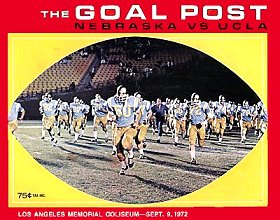
Bruins Ruin Nebraska Streak in 20-17 Upset
By Gary Rausch Long Beach, CA Independent Press-Telegram Staff Writer
The Big Red fell for the first time in 33 games on Efren Herrera's 30-yard field goal with only 22 seconds to play, 20-17. For most of the 67,702 gathered in the Coliseum- save those 15,000 rabid Cornhusker followers- it would have been a miscarriage of justice to see it end any other way.
Pepper Rodgers authored a near-perfect defensive game plan that effectively shut off the powerful Nebraska running game, forced the Huskers into slightly uncomfortable passing situations and then worked a blended passing-running attack offensively that capitalized on just about every Husker miscue.
"When they fumbled, we were there to fall on them," said Rodgers between gulps of cola. "When they passed, we were there to catch them."
"Offensively, we did just what we wanted," Pepper bubbled. "We moved the ball consistently on the ground and popped a big one or two in the air. We knew the long runs would be tough."
On the final drive, the Bruins couldn't have been in a more perfect situation. They were eating up the clock on the running of James McAlister. Kermit Johnson, Gary Campbell and Mark Harmon while getting within range for a Herrera three-pointer.
"It still hasn't hit me," Harmon said of the upset which was heard clear across the nation. "It's all like a mirage. After we scored that first touchdown, I knew we could score again."
Harmon shared the spotlight with McAlister. The junior halfback whose long-awaited debut was an 18-carry, 90-yard showcase of durable running.
There had never been any question about McAlister's ability, but there were some doubting Thomases in Harmon's case, especially his passing. He dispelled them by hitting 4 of 8 for 65 yards and the Bruin touchdown, a 46-yard toss to Brad Lyman.
Defensively, the Bruin heroes who held Nebraska to 174 rushing yards included sophomore linebacker Hershel Ramsey, cornerback Jimmy Allen and ends Cal Peterson and Fred McNeill.
Ramsey was in on 13 tackles. McNeill 9 and Peterson 8. Peterson also recovered two fumbles while Allen made 8 stops and intercepted sophomore David Humm twice.
The harassed Humm hit on only 8 of 21 throws, but one completion put Nebraska back in the game less than a minute into the final quarter- a 44-yard scoring toss.
Fearing the wondrous speed of Johnny Rodgers, the Bruins were solidly guarding the sidelines. An unnoticed tight end, Jerry List, slipped into the unattended center zone, grabbed a short lob and rambled untouched to the goal line for a 17-17 tie.
Nebraska let it be known right from the beginning that its game plan was to slug it out with UCLA inside the tackles, slip Rodgers around the ends once in awhile and pass only when it had to.
McAlister's first carry as a Bruin will go down in the annals as a 35-yard gain. James was all but stopped for a two-yard gain, but kept his powerful legs churning.
UCLA got its first of many breaks a moment later when Cal Peterson and Rick Baska unloaded on fullback Bill Olds, who coughed up the ball. Peterson recovered at the Nebraska 35. Eleven plays later Herrera connected on a 27-yarder.
Break No. 2 occurred five plays into the next period when tailback Gary Dixon blasted through left guard and into open field. Alan Ellis stopped him with a driving shoulder tackle. Dixon went one direction, the ball another. Peterson was on the spot again, recovering at the NU 46.
Harmon caught the Big Eight visitors by surprise on the next play, faking his backs into the line before rolling right and firing deep to Lyman.
|
||
|
||
|
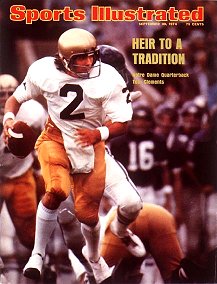
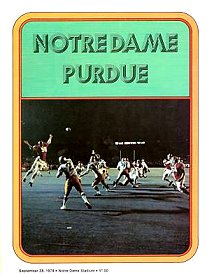
Boilers Take Fight Out of Irish By Mark Morrow Assistant Sports Editor Kokomo Tribune
Alex Agase and his stout-hearted Purdue football team became firm believers here Saturday afternoon in Notre Dame Stadium as the Boilermakers pulled off a stunning 31-20 upset of No. 2-ranked Notre Dame.
A shocked partisan Irish crowd (59,075) looked on in disbelief as the supposedly-ragged, heavy underdog Boilermakers came of age in a hurry, hammered the defending National Champs in a vicious manner, and cut college football's longest winning string into little pieces.
It was a great day in Purdue football history as the 1-1-1 Boilermakcrs, not given a ghost of a chance to derail the high-powered Irish machine, registered their first victory over Notre Dame since 1969 and dented the nation's longest win string for the second successive week.
Purdue, which marred Miami of Ohio's 13-game string by battling the Redskins to a 7-7 standoff a week ago, simply dropped a bomb on Notre Dame's 13-game string in the 46th meeting between the bitter intra-state rivals.
Agase, who said the oddsmakers didn't know what they were talking about during a pre-game interview, was in the height of his glory as his battle-weary Riviters used an alert, bone-crushing defense and a quarterback with a bruised shoulder to dismantle the 2-1 Irishmen.
Purdue, showing the strength of a bull, the desire of a racehorse and the heart of a lion, shellshocked Notre Dame with a 24-point outburst in the first quarter and the handwriting was on the wall.
Notre Dame, however, didn't buckle...but that early Purdue explosion forced the Irish to change their game plan and they were in a state of confusion for the most part.
It was the most points ever scored against Notre Dame in opening 15 minutes of play...and the Irish, despite staging an awesome passing game, didn't have what it takes to dig themselves out of the deep, dark hole.
Tom Clements cut Purdue up with Pete Demmerle, Robin Yoder and halfback Ron Goodman on the receiving end...but that tenacious Boilermaker defense, led by Ken Novak, Jappy Oliver, Jim Wood and Fred Cooper, came up with the big play when they had to have it.
Steve Schmidt, who watched from the sidelines last week when Bill Stinchcomb couldn't land the winning field goal, got the call and turned things around this trip. He shot one through from 47 yards with 2:13 left in the first period to give Purdue that bulging 24-0 lead.
Notre Dame wasn't out of it by any stretch of the imagination...and the Irish were defensive demons in the second half. But those determined Purdues wouldn't give ground.
The Irish failed repeatedly to take advantage of breaks in the second half. Ara's Warriors, playing most of the game in Purdue territory, were stopped four times on fourth down situations as they couldn't keep the Boilers on the run.
Quarterback Mark Vitali, taking over for the injured Terrizzi, fumbled a snap on the punt at his own 26 early in the third quarter. It took the Irish five plays before Bullock went in from the one to cut the Boiler lead to 24-14 with 12:36 left.
Mike Northington scored from six yards out on a fourth down to pretty well ice things for Purdue with 9:23 left in the contest.
Notre Dame still had slim hopes with 4:37 remaining as Clements fired a 29-yard scoring strike to Demmerle. But Purdue stopped the two-point conversion attempt and it remained 31-20.
The Boilers drove from their own 16 to the 50 on the next series of downs, came up with two key first downs, and were home free with :48 showing even though Vitali was forced to punt the football away.
The first half found Purdue fired to the brim and the Boilers harrasscd Notre Dame unmercifully as they struck early, hit hard, and made the most of Irish mistakes. It was 21-0 (7:22 left) before the Irish knew what hit 'em.
After the opening kickoff, Al Samuel fumbled on the second play from scrimmage (14:29 showing) as Cooper jarred the ball loose and Oliver pounced on it at the Irish 32.
Facing a third-and-12 situation, Terrizzi found Olympic sprinter Larry Burton all alone at the 10 and he fell forward to give Purdue a first-and-goal at the seven.
Purdue drove to the one where Notre Dame held on three successive plays, then Terrizzi rolled right for the score after a brilliant fake to the middle to Scott Dierking.
With 8:03 left in the first stanza, Pete Gross broke a tackle at the 50 (he went off left tackle) and scrambled to paydirt on an electrifying 52-yard run. It was 14-0 following Schmidt's second PAT.
The straw that broke the camel's back came about at the 7:22 mark when linebacker Bob Mannella ran between Demmerle and the football, hauled in Clements' pass at the 21, and had daylight ahead of him.
The lead ballooned to 24-0 with 2:13 remaining when the sure-footed Mr. Schmidt banged a 47-yard field goal, which equaled the Purdue school record set by Mike Renie (Tipton product) in 1970.
But despite the sudden turn of events, the Irish weren't about to roll over and play dead. Clements went to the air and got 'em rolling.
The first scoring drive for the Irish, which covered 80 yards on 12 plays, ended at the 11:02 mark of the second act when Bullock crashed over from the two.
From there, Notre Dame had two golden opportunities to kick field goals deep in Purdue territory, but Parseghian elected to go for TDs and Purdue held ground.
Purdue won the rushing battle (225-165), but Notre Dame had the edge in passing (261-106). Gross paced the Boiler ground attack with 93 yards on 19 trips while Greg Pruitt and Scott Dierking rushed for 39 and 38 yards, respectively.
Terrizzi hit on one of four passes for 27 yards while Vitali was good on six seven for 79 yards. Clements put the ball in the air 37 times and connected on 22 for 264 yards while Demmerle was tops in receptions with eight grabs for 121 yards.
Burton came up with six catches that totaled 92 yards.
Bullock was the Irish workhorse on the ground. He rushed for 67 yards on 16 carries and Samuel collected 42 yards in nine trips.
|
||
|
||
|
Controversy Mars Upset Of Bucks
It took Duke nearly 30 minutes to confirm what a delirious, disbelieving capacity crowd of 78,533 had seen- that Michigan State had held on a goal-line stand with seconds to play and Ohio State, out of timeouts, had not gotten its final play off in time from the one-yard line
"It was the ruling of the back judge and the field judge that play had expired before the last play,” Duke said of the confusion-filled final seconds.
The line judge had briefly signaled an Ohio State touchdown but Duke said the Buckeyes would have suffered a penalty on the play had time not run out. Wingback Brian Baschnagel picked up a fumbled snap at the final gun and plunged into the endzone. But the play, as it turned out. didn't count.
When the gun went off, both teams, believing they had won, broke into victory dances as the crowd swarmed onto the Spartan Stadium field and surrounded the two squads
The game ended in tumult as a capacity crowd of 78,533 jammed the football field when the Buckeyes tried to get off one last play from the Michigan State one-yard line as the final gun sounded.
The Spartans had scored just moments before Jackson's shocking dash on a 44-yard touchdown pass from quarterback Charlie Baggett to Mike Jones to bounce back from an Ohio State touchdown and a 13-3 deficit.
The defeat derailed the Buckeye express from its final-game showdown with fourth-ranked Michigan and represented the first regular-season defeat for Ohio State since the Spartans upset them here two years ago.
Michigan State waited until late in the game to capitalize on its stubborn defense, which throttled the high-powered Ohio State attack, including star tailback Archie Griffin, all day.
The crowd went beserk as Jackson raced down the right sideline nearly the length of the field. Later, the fans tore down both goalposts
Placekicker Tom Klaban had given Ohio State two earlier leads with short field goals after the Spartans stalled three Buckeye probes inside the Michigan State 10-yard line.
His first kick came after the only strong drive of the day for Ohio State, a 22-yarder midway in the first period to give the Buckeyes a 3-0 lead.
Michigan State tied it with two seconds to go in the half on a 39-yard field goal by freshman Hans Nielsen
The kick followed an Ohio State fumble by quarterback Cornelius Greene and a 30-yard scramble by Baggett.
The third quarter began with a 16-play OSU drive to the Spartans' three-yard line, capped by Klaban's second field goal, a 20-yarder.
In the last period, Baggett fumbled in the open field after dashing for a large chuck of yardage and Ohio State recovered, then the Buckeyes marched for their only touchdown of the day. Champ Henson plunging over from two yards out.
But Michigan State rebounded on the strong arm of Baggett and the flashing feet of Jackson for its two lightning scores before the disbelieving and overjoyed crowd.
View Levi Jackson's run by clicking HERE.
|
||
|
||
|
KU's Upset Of Sooners Still Vibrating
From News Wires
The unranked Jayhawks not only pulled off the biggest upset of the 1975 season, but they did it by a mind-boggling score of 23-3. It was the first time the Sooners had been held to less than a touchdown in 99 straight games, going back to a shutout by Notre Dame in 1966.
First-year Kansas Coach Bud Moore called it one of the greatest victories in college football history.
Oklahoma coach Barry Switzer, unbeaten in his three years as Sooner head man, looked back on the defeat several hours after the game and said, “I’ve experienced both winning and losing and I’ll tell you, I like the other (winning) a hell of a lot better."
Before anyone could utter a word about his first loss as a head coach, Switzer said, "At least one good thing happened to me today. When I got home after the game my six-year-old daughter took me aside and bent me down and whispered in my ear, 'I don't care if you did get beat, I still love you, Daddy.'”
"I'd like to think nobody put her up to that," Switzer said.
Switzer had actually written the script for Oklahoma's first loss earlier in the season when asked what it would take to defeat the Sooners, who had won 28 straight games since a 7-7 tie with Southern California in 1973.
"We'll get beaten if we make too many mistakes against a good football team," he said then.
That's exactly what happened Saturday before a paralyzed partisan Sooner crowd of 70,286.
The Sooners had manhandled Kansas in the early going, but only had a 3-0 lead on Tony DiRienzo's 52-yard field goal.
Eddie Lewis' block of a Tinker Owens punt gave Kansas the ball on the Sooner seven with 1:25 left before the half. A brilliant six-yard run by quarterback Nolan Cromwell put the Jayhawks ahead, 7-3, at intermission.
From then on it was all Kansas as the Sooners fumbled on three straight possessions in the third period and Kansas converted two of the turnovers into a 17-3 lead on Laverne Smith's 21-yard run and a 32-yard field goal by Bob Swift. Smith later scored on an 18-yard run to wrap up the stunning victory.
No one expected Kansas, now 6-3, would be the team to derail the proud Sooners. The Jayhawks came into the game severely crippled on defense, but a fanatical effort helped produce those Sooner errors and put the Jayhawks suddenly in the post-season bowl picture.
"They just made too many mistakes to win," Kansas linebacker Rick Kovatch said. "We knew if we stuck them, they'd fumble, and they did. We just went in looking for the ball on the ground."
Oklahoma must now regroup for two tough final games. The Sooners go to Missouri Saturday and then play Nebraska on Nov. 22 in a game that will probably decide the Big Eight championship.
"Youth is a great thing- they'll bounce back," Switzer said of the fallen Sooners.
The defeat was the first on the collegiate level for many of the Sooners, including quarterback Steve Davis.
"We'll just have to start again. You can't win everything all of your life," said Davis, a licensed Baptist minister.
Oklahoma's unbeaten string of 37 games had been exceeded by only three major college teams in the past fifty years. California had 46 victories and four ties under Andy Smith in 1920-25 and Bud Wilkinson's 1953-57 Oklahoma teams won 48 straight. The loss prevented the Sooners from surpassing the 37-0-2 streak of Notre Dame under Frank Leahy in 1946-50.
Switzer appeared at the post-game news conference after the game, and typical of the afternoon, fumbled a package of cigarettes upon entering the conference room. But he didn't fumble the interviews.
The youthful coach had nothing but praise for Kansas and even managed a few jokes. "They (the Jayhawks) are a good football team," he said. "Not necessarily the best football team wins every time. Bud Moore knows that. But, Kansas played a great game. I think that if it had been an error-free football game it still would have been very close. Kansas might have won anyway. But I'd like to have found out."
"I got beat and I didn't even take a pro job," Switzer joked, with reference to Southern California's John McKay.
He knew it would hurt more later, Switzer said, but for the moment the interchange would be lively, cheerful and candid.
"Tomorrow when I'm by myself and it's quiet, that's when it kind of hits you a little more." he said.
The most disturbing thing about the 23-3 loss to Kansas, he said, was the Sooners failure to score early in the game.
"The most disappointing thing occurred in the first few minutes of the ball game when we could easily have had a 14 or 17-point lead." he said.
He said he couldn't explain all the lost fumbles.
"Those things happen sometimes, that's football," he said. Some of them were weird, he said, such as the time Elvis Peacock reached the one-yard line and the ball was fumbled backward to the seven.
"We've won a lot of ball games the same way," he said.
Switzer was asked what he told the players after the game.
"We just got together and talked about what we've accomplished," he said. “I told them they have nothing to be ashamed of. They can look everybody in the eye and hold their heads up.”
"We've got to prepare for the two games we've got coming up. We can still win the Big Eight and go to the Orange Bowl. We've got to meet adversity."
|
||
|
||
|
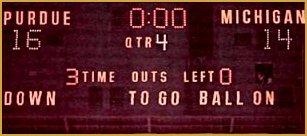
Purdue Pulls Off Miracle
By Kurt Freundenthal Logansport, IN Pharos-Tribune
This past Monday the MSU embarrassment had been forgotten.
"We won't have any problems getting our players up for Michigan," Agase said Monday. "We're out to regain our respectability."
The "intensity" which was missing in the Michigan State game was apparent from the opening whistle Saturday and even when Michigan grabbed a 14-13 lead in the third period, none of the more than 57,000 fans went home. A tense feeling of excitement prevailed in Ross-Ade Stadium. The home fans were not disappointed.
"We couldn't have gained back our respect any better than by beating the No. 1 team," said a grinning and perspiring Agase in the jubilant and steaming dressing room. "This is the happiest moment of my lifetime. It was a great, great team win."
Although he refused to single out any one player, Agase called veteran tailback Scott Dierking, who scored Purdue's two touchdowns, "still the best back in this Big Ten Conference, one of the best in the country."
"We came to get our respect back," Agase said. We took a step backward last week but went 99 steps forward Saturday. Thank God our guys believed in themselves and the things they're doing. I wouldn't trade this win for anything."
Dierking said Purdue "had to win the game for Coach Agase. He's the greatest guy I've ever been associated with."
Supan said he didn't have time to get nervous before his game winning field goal, his fifth of the season. "I just went out and kicked the ball and the feeling I had was the best in my life," Supan said.
"I knew it was going to be a tough one, even before the season started," said Michigan Coach Bo Schembechler. "It was one of the four games we were shooting for. After Purdue looked so bad against Michigan State, maybe we didn't shoot for it hard enough. We knew we were going to have a tough time."
It was the first time since 1969 that the Wolverines lost to a conference rival other than Ohio State and the first time in their last eight meetings that Purdue has beat Michigan.
Dierking, who missed the last two and one-half games with a sprained ankle, scored two touchdowns and gained 162 yards in a school record 38 carries.
Quarterback Mark Vitali connected on 10 of 14 passes for 110 yards but had two picked off.
Michigan scored first in the opening period when quarterback Rick Leach ran eight yards for a touchdown after a fumble recovery, but minutes later Dierking scored his first tally on a four yard run- also after a fumble recovery. Two big plays set up the touchdown, a 20-yard pass from Vitali to Ray Smith and John Skibinski's 19-yard run to the Michigan four.
Dierking's 25-yard run in the second period gave Purdue a 13-7 halftime lead, but Michigan seized control at the start of the third period when Leach rifled a 65-yard touchdown pass to Jim Smith and Bob Wood converted for a 14-13 Michigan lead.
When Blane Smith recovered Rob Lytle's fumble on Purdue’s 29-yard line with just under 12 minutes to go, Purdue launched its winning drive. Dierking and Skibinski alternated carrying the ball, Vitali fired a 19-yard pass-to Skibinki to the Michigan 11 and four plays later Supan booted his game winning field- his fifth three-pointer of the season.
Michigan, fighting the clock, had one more shot at pulling the game out but the drive fizzled on the Purdue 19 and, with 14 seconds left, Wood missed a 37-yard field goal attempt.
Hundreds of fans swarmed onto the field and the game was stopped until order was restored and Purdue ran out the final nine seconds.
The victory evened Purdue's Big Ten record at 3-3.
Lytle, who became the third Michigan ball carrier to log more than 1 000 yards in two consecutive seasons, had 153 yards rushing in 21 attempts. Leach completed only two of eight passes for 79 yards.
In total offense, it was virtually a standoff with Purdue gaining 360 yards to 355 for the Wolverines. Purdue did not have to punt in the first half and controlled much of the tempo of the game to take its one touchdown lead at intermission.
|
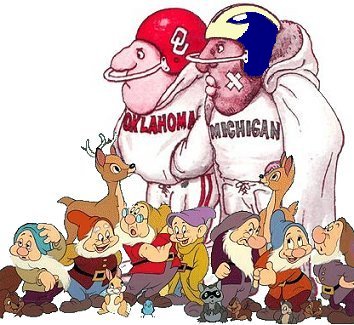 In
the 1970’s, the world of college football changed dramatically. Two
powers, television and college presidents began wielding increasing
power over the decision making in college sports and Title IX reduced
the amount of scholarships that could be offered in the sport. A certain
“parity” began to be seen. In the 1960’s and 1970’s, the major powers in
college football controlled the landscape. The Big Eight (now Big
Twelve) was dominated by Nebraska and Oklahoma. It became known as the
‘Big Two and Little Six”. The Big Ten was likewise dominated by Michigan
and Ohio State. Thus, the moniker, “Big Two and Little Eight”. Bear
Bryant and his Alabama squads ruled the Southeast Conference. The Pac 8
(now Pac Ten) was the domain of Southern Cal. Even the old Southwest
Conference was a two team affair, Arkansas and Texas. And, with the
exception of the rise of Pitt in 1977, Penn State controlled the East.
The ACC was insignificant after the decline of Duke and Maryland, powers
in the 1950’s.
In
the 1970’s, the world of college football changed dramatically. Two
powers, television and college presidents began wielding increasing
power over the decision making in college sports and Title IX reduced
the amount of scholarships that could be offered in the sport. A certain
“parity” began to be seen. In the 1960’s and 1970’s, the major powers in
college football controlled the landscape. The Big Eight (now Big
Twelve) was dominated by Nebraska and Oklahoma. It became known as the
‘Big Two and Little Six”. The Big Ten was likewise dominated by Michigan
and Ohio State. Thus, the moniker, “Big Two and Little Eight”. Bear
Bryant and his Alabama squads ruled the Southeast Conference. The Pac 8
(now Pac Ten) was the domain of Southern Cal. Even the old Southwest
Conference was a two team affair, Arkansas and Texas. And, with the
exception of the rise of Pitt in 1977, Penn State controlled the East.
The ACC was insignificant after the decline of Duke and Maryland, powers
in the 1950’s.
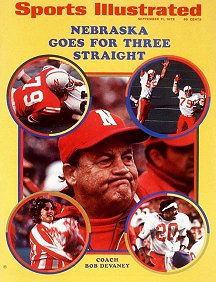
 There will be other monumental upsets in this
season of football madness, but none will be as perfectly executed nor
so pleasantly savoring as the demise of Nebraska's two time national
champions by UCLA's deadly sword Saturday evening.
There will be other monumental upsets in this
season of football madness, but none will be as perfectly executed nor
so pleasantly savoring as the demise of Nebraska's two time national
champions by UCLA's deadly sword Saturday evening. But the key play was a Harmon to Jack Lassner
pass on a third-and-11 situation at the Nebraska 33. Lassner made the grab at
the 20 between three defenders. It was a splendid varsity debut for
Harmon, the JC transfer from Pierce. He ran the wishbone with authority,
leading the Bruins in carries with 21. He gathered 71 yards on his
darting keepers off the option and some gutty sneaks into the teeth of
Nebraska's feared Black Shirt defense.
But the key play was a Harmon to Jack Lassner
pass on a third-and-11 situation at the Nebraska 33. Lassner made the grab at
the 20 between three defenders. It was a splendid varsity debut for
Harmon, the JC transfer from Pierce. He ran the wishbone with authority,
leading the Bruins in carries with 21. He gathered 71 yards on his
darting keepers off the option and some gutty sneaks into the teeth of
Nebraska's feared Black Shirt defense.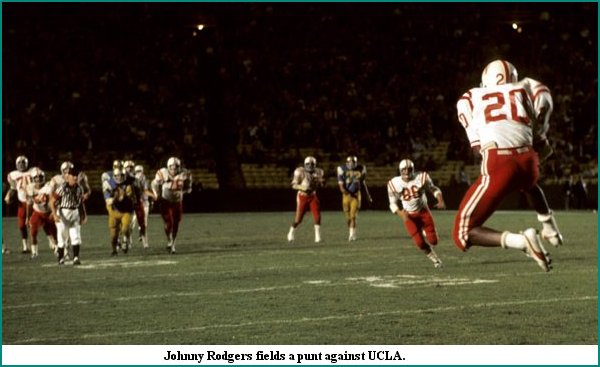
 SOUTH BEND- Are you one who thinks a mouse
should have the chivalry to trade bites with a cat? Can you see a kitten
trying to claw a lion? Who ever thought David would take a swing at
Goliath?
SOUTH BEND- Are you one who thinks a mouse
should have the chivalry to trade bites with a cat? Can you see a kitten
trying to claw a lion? Who ever thought David would take a swing at
Goliath?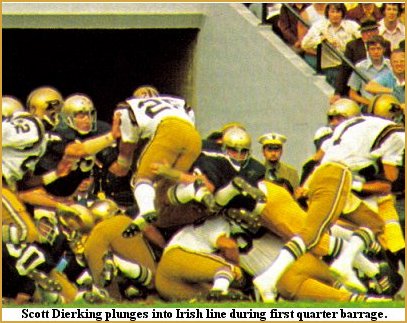 Wayne Bullock, who scored two of Notre Dame's
three TDs, got the Irish on the board with 11:02 left in the second
period as they regrouped and dominated play...but Purdue still clung to
a 24-7 edge at halftime.
Wayne Bullock, who scored two of Notre Dame's
three TDs, got the Irish on the board with 11:02 left in the second
period as they regrouped and dominated play...but Purdue still clung to
a 24-7 edge at halftime.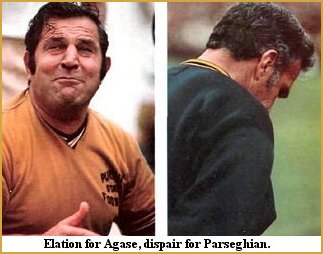
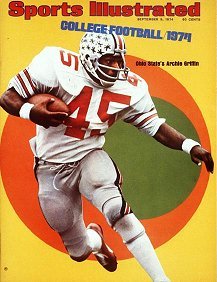
 East
Lansing, Mich. (AP) Michigan State
stunned top ranked Ohio State 16-13 Saturday on an electrifying 88-yard
touchdown run by fullback Levi Jackson and a post-game ruling by Big Ten
Conference Commissioner Wayne Duke.
East
Lansing, Mich. (AP) Michigan State
stunned top ranked Ohio State 16-13 Saturday on an electrifying 88-yard
touchdown run by fullback Levi Jackson and a post-game ruling by Big Ten
Conference Commissioner Wayne Duke.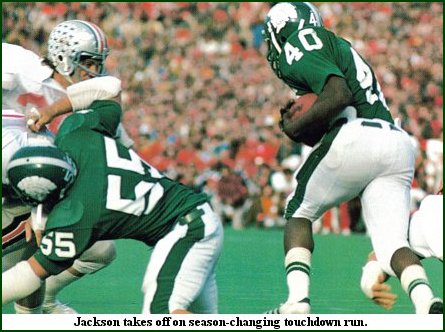 Ohio State saw its record drop to 8-1 overall
and 5-1 in the Big Ten while the drastically improved Spartans jumped to
5-3-1 and 4-1-1 in the conference.
Ohio State saw its record drop to 8-1 overall
and 5-1 in the Big Ten while the drastically improved Spartans jumped to
5-3-1 and 4-1-1 in the conference.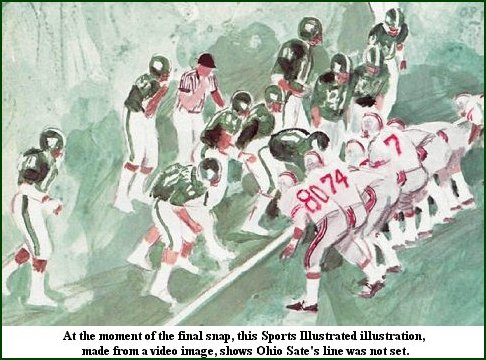
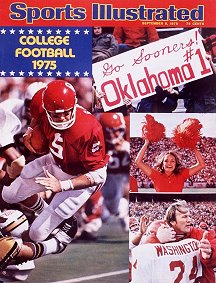
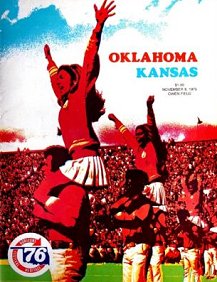 Norman, Okla.- The Kansas Jayhawks could
have flown home to Lawrence, Kan., on their own power Saturday afternoon
after halting Oklahoma's unbeaten string of 37 games, the fourth longest
in the past half century of major college football.
Norman, Okla.- The Kansas Jayhawks could
have flown home to Lawrence, Kan., on their own power Saturday afternoon
after halting Oklahoma's unbeaten string of 37 games, the fourth longest
in the past half century of major college football.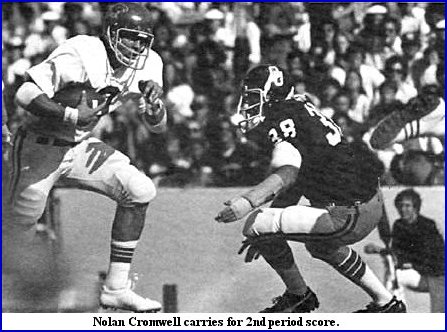 Beginning with a blocked punt before
intermission, the Sooners suffered nine straight turnovers, including
four lost fumbles and four interceptions.
Beginning with a blocked punt before
intermission, the Sooners suffered nine straight turnovers, including
four lost fumbles and four interceptions.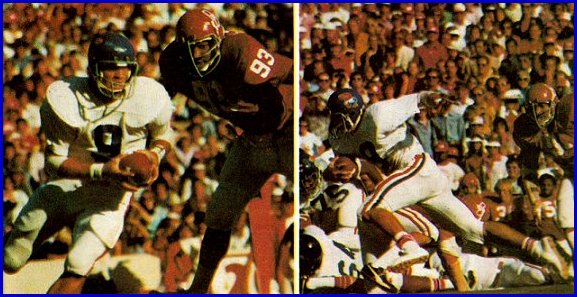
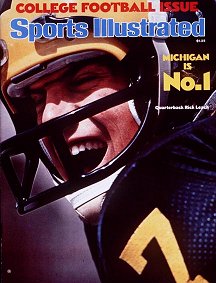
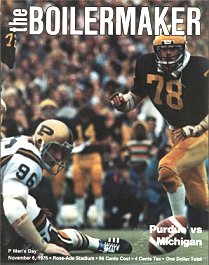 WEST LAFAYETTE, Ind. (UPI) - All Purdue's
Boilermakers wanted Saturday was to regain their respectability,
instead, they shocked the college football world with the biggest upset
of the season- a 16-14 thriller over No. 1 ranked Michigan on Rock
Supan's 23-yard field goal with 4:20 left to go. A week ago Purdue was
blasted at Michigan State, 45-13 for its third consecutive loss in what
Coach Alex Agase called a "lousy" performance.
WEST LAFAYETTE, Ind. (UPI) - All Purdue's
Boilermakers wanted Saturday was to regain their respectability,
instead, they shocked the college football world with the biggest upset
of the season- a 16-14 thriller over No. 1 ranked Michigan on Rock
Supan's 23-yard field goal with 4:20 left to go. A week ago Purdue was
blasted at Michigan State, 45-13 for its third consecutive loss in what
Coach Alex Agase called a "lousy" performance.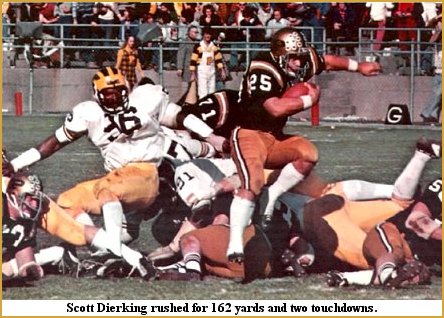 The loss wrecked Michigan's bid for an
unbeaten season and the 5-1 Wolverines now may have to beat Ohio State
in their season finale Nov. 20 to qualify for the Rose Bowl.
The loss wrecked Michigan's bid for an
unbeaten season and the 5-1 Wolverines now may have to beat Ohio State
in their season finale Nov. 20 to qualify for the Rose Bowl.