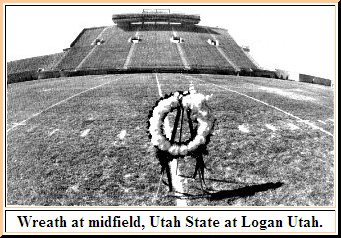
Personal Note: I was raised in Central Kansas. It was October of 1970 and I was 11 years old. I remember it like it was yesterday. I walked into the house and into the living room that Friday afternoon anticipating a fun weekend. Then, I saw their faces and knew something was very wrong. My mother said, “The Wichita football plane went down.” Those were the horrible words that rippled across Kansas and the nation. There will always be a feeling there, something inside each of us that remembers. Almost 40 years have passed and the movie “Marshall” has bought to attention once again the tragic events of that program a week later. It was a dark time in the college football world.
I remember going to an oilfield with my father. My dad would find a large oil tank battery out in the country and park near it to get better reception on his car radio. As an oilman, he had discovered this antenna effect. We were true football fans. That Saturday night, sitting there with my father in the dark, we listened to the deafening roar of a stadium full of people at Little Rock. We listened to the cracking voice of Gus Grebe, Wichita radio personality, as he struggled to maintain his composure. He described the gracious Arkansas fans and the Shockers taking the field. Then, a few weeks later, I was again driving with my father. This time, on a Saturday afternoon on a country road. The Shockers jumped out to a 17-0 lead over league champion, Louisville. Again, Gus Grebe was crying and, at times, speechless.
Today, there is no football program at Wichita State. The program folded for financial reasons in 1986. Some contend that WSU never fully recovered from the tragedy of 1970. But, that argument was rendered moot by the actions of the crash survivors in the weeks that followed. The program continued and proved that the strength and valor of youth cannot be destroyed by flame or heartache. This is the story of those tragic and inspiring weeks follow.
On October 2, 1970, a plane carrying 40 persons crashed into a mountain near Silver Plume, CO in the Rocky Mountains killing 31, including 14 WSU players, 14 members of the Wichita State family, and three crew members. The plane was bound for Logan, UT and a game with Utah State. Killed in the accident were head coach Ben Wilson, athletic director Bert Katzenmeyer, and dean of admissions Carl Fahrbach. Those who died in the tragedy were:
|
Players: |
|
|
Marvin Brown |
Don Christian |
|
John Duren |
Ron Johnson |
|
Randy Kiesau |
Mal Kimmel |
|
Carl Krueger |
Steve Moore |
|
Tom Owen |
Gene Robinson |
|
Tom Shedden |
Richard Stines |
|
John Taylor |
Jack Vetter |
|
Staff and Boosters: |
|
|
Marian Katzenmeyer |
Ray Coleman |
|
Bert Katzenmeyer |
Maxine Coleman |
|
Helen Wilson |
John Grooms |
|
Ben Wilson |
Carl Fahrbach |
|
Tom Reeves |
Etta Mae Grooms |
|
State Rep. Ray King |
Marty Harrison |
|
Yvonne King |
Floyd Farmer |
|
Crew: |
|
|
Dan Crocker |
|
|
Judy Lane |
|
|
Judy Dunn |
|
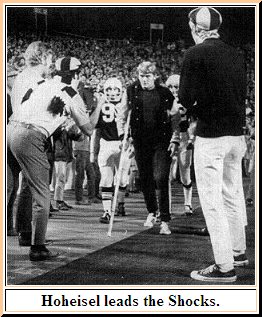
In a heroic vote, the decision was made to continue the season and, on Oct. 24, 1970, the Shockers met #9 ranked Arkansas at Little Rock under former assistant coach, Bob Seaman. John Hoheisel, a linebacker who survived the crash, led the black jersey-ed Shockers onto the field for the coin toss before a standing ovation of 40,000 fans. A freshman quarterback named Tom Owen guided the Shockers. The outcome was never in question for the team comprised of survivors, second teamers, and freshmen as Arkansas prevailed 62-0. Following the game, Arkansas players rushed onto the field to hug their WSU counterparts as the fans gave them another standing ovation. During that “Second Season”, Wichita lost to Tulsa in a tough contest and took a shocking 17-0 lead on league champion, Louisville, in the 2nd quarter. The Shocks eventually lost to the Cardinals 34-24. In fact, they lost all of their games in 1970. But, they won the hearts of WSU fans and the nation.
Wichita Resumes Schedule
By HERSCHEL NISSENSON
Associated Press Sports Writer
 October
24, 1970- The last game of football Marvin Kellum played was for his
eight-man high school team in LeCompton, Kan. Tonight he'll be in the
defensive backfield when Wichita State takes the field for the first
time since the tragic airplane crash three weeks ago that took the lives
of 13 players- all first-stringers- and 17 other persons.
October
24, 1970- The last game of football Marvin Kellum played was for his
eight-man high school team in LeCompton, Kan. Tonight he'll be in the
defensive backfield when Wichita State takes the field for the first
time since the tragic airplane crash three weeks ago that took the lives
of 13 players- all first-stringers- and 17 other persons.
The Shockers would have had their work cut out in any case, having been walloped by Texas A&M, Arkansas State and West Texas State. Now all they have to face is Arkansas, ranked ninth in The Associated Press poll and winner of four consecutive games following an opening loss to Stanford. The game is scheduled for Little Rock under the lights.
Bob Seaman, who took over as head coach replacing Ben Wilson, who was killed in the Oct. 2 crash, has a squad of three seniors, six juniors, 24 sophomores and 43 freshmen. The Missouri Valley Conference okayed the use of freshmen for the rest of the season.
"It's a football game and we've got to get ready as best we can for it," said Seaman. "The psychological part will take care of itself. These young men will come to play. Playing football is absolutely the best therapy that could have happened to them."
Arkansas' Frank Broyles, whose major problem undoubtedly will be keeping the score respectable, said: "We're proud that we're having a chance to help them recover from their tragedy. They need to play the game if they're to continue their program and develop their players.
Arkansas Cleans Bench In Holding Score To 62-0
By E. MICHAEL MYERS
LITTLE ROCK, Ark. (UP1)
October 25, 1970- The ninth-ranked Arkansas Razorbacks with the first unit out early in the game, scored on their first four possessions Saturday night and crushed the tragedy weakened Wichita State Shockers, 62-0.
Arkansas Coach Frank Broyles sent in his reserves mid-way in the first period as Arkansas jumped to a 20-0 lead. Wichita State, in its first game after an Oct. 2 team plane crash in Colorado killed 13 players, the coach and athletic director, had 10 sophomores and 7 freshmen on its starting unit.
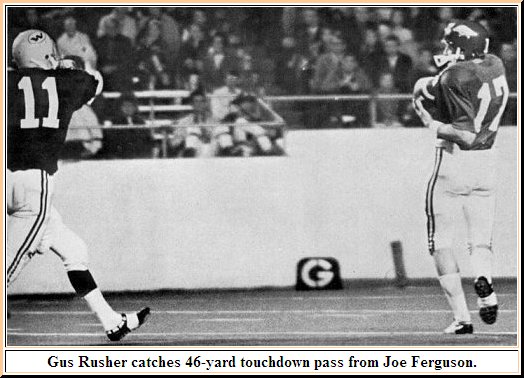
Starting Arkansas quarterback, Bill Montgomery, hit flanker Jim Hodge on a 69-yard scoring pass on the third play of the game and reserve signal caller, Joe Ferguson, had touchdown strikes of 34 and 46 yards.
Wichita was clawed by the Arkansas defense. Broyles played 61 players, nearly everyone on the bench.
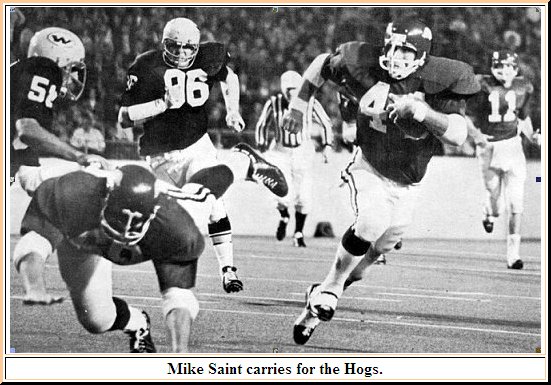
Wichita stalled on its first possession and tailback, Joe Richardson, sailed 60-yards to score on the punt return. Kicker, Bill McClard, hit first period field goals of 53 yards- a school record- and 27 yards as the reserves took over. Tailback, Mike Saint, dove across from the one and split end, Mike Reppond, took a 34-yard strike from Ferguson as Arkansas led 34-0 at the half.
Ferguson also tossed a 46-yard touchdown pass to Gus Rusher, defensive back, David Hogue, scored on a 24-yard pass interception return and running back, Peyton Speck, had a 7-yard TD dive.
Reserve quarterback, Walter Nelson, ended the Arkansas barrage with a seven-yard run with 2:40 left in the game.
Wichita made its initial first down in the third period, but their drive faltered at the Arkansas 28.
Porker Players Fans' Sympathy Went to Wichita
October 26, 1970
LITTLE ROCK, Ark. (UPI) - The official's final gun sounded and the benches emptied. But the Arkansas Razorbacks were not heading for the dressing room. Not yet.
They raced across the astroturf, meeting the Wichita State Wheatshockers at midfield. The scoreboard showed a 62-0 Arkansas victory, a devastating defeat for the young men from Kansas.
But, Arkansas showed only respect and admiration for the tragedy-scarred Wheatshockers, a team of more than 40 freshmen and sophomores.
"They were fired up before the game and they were still fired up when it was over," said Razorback Joe Ferguson, a reserve quarterback who threw two touchdown passes against Wichita.
"They spontaneously wanted to go over and talk with the Wichita players." Arkansas coach Frank Broyles said Sunday. "It was the first time we ever did anything like it."
And in the stands, 40,000 Razorback enthusiasts roared their admiration for the visiting team, another unusual sight in War Memorial stadium in which only the sounds of "Sooey, Pig" usually roar.
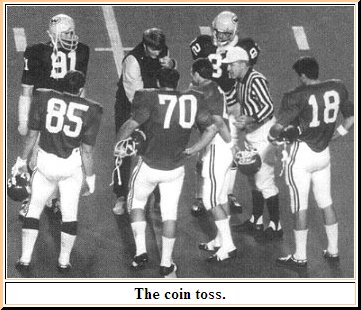 At the start of the game
the Wichita team captain hobbled on his crutch to midfield for the
pre-game coin toss. John Hoheisel had a cast on his left leg, but he was
the elected captain of the Wichita State University football team and
his teammates wanted him on the field for their first game since 13
players were killed in an Oct. 2 airplane crash.
At the start of the game
the Wichita team captain hobbled on his crutch to midfield for the
pre-game coin toss. John Hoheisel had a cast on his left leg, but he was
the elected captain of the Wichita State University football team and
his teammates wanted him on the field for their first game since 13
players were killed in an Oct. 2 airplane crash.
"It was a funny feeling, going out on the field," he said. "I wish I was out there playing. But, I guess I should be glad to be alive. Just after that plane crashed I didn't think I would ever see another football game."
Wichita started its "second season" against one of the nation's best teams. After an Oct. 2 flaming plane crash in the Colorado Rockies killed 13 players, the school's coach, athletic director and 15 others, the crippled Wheatshockers regrouped and fought to the final seconds.
But their inexperience- there were 10 sophomores and seven freshmen on the starting units- was too much to overcome.
Broyles had trouble in preparing for the game- "we just couldn't get up for it because of its sympathetic nature." But the Razorbacks knew Wichita expected no favors.
Because of the unique circumstances, Broyles said the Arkansas coaches dreaded the week before the game.
"We didn't try to get them emotionally involved," he said, "There were no pep talks. That would have been out of order. We just worked on blocking and tackling for Texas A&M and let the score take care of itself," Broyles said.
"I was never more proud of our fans, our student body and our players."
Tailback Bill Burnett, who has a chance at Steve Owens' career touchdown record, didn't suit out even though Broyles said he could have played.
"This game will hurt Bill Montgomery's average and the statistics of Chuck Dicus,"
Broyles said. "Bill Burnett could have scored a couple of touchdowns but it wasn't that kind of game."
Bob Seaman, Wichita coach, said: "These are great people. And Coach Frank Broyles is a fine gentleman. He could have made it 150-0, but he put in the second and third teams."
"I don't care what that thing says," said an Arkansas fan, looking at the scoreboard, "they didn't lose."
October 2, 1970
A beautiful fall day...then an ominous sound
by Lauretta McMillen
Wichita Eagle, 9/30/1990
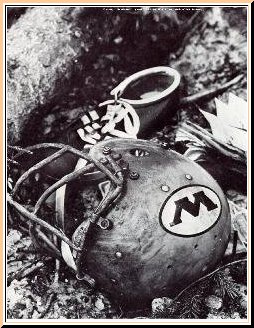 "And every year since, the second of October has almost always been a
beautiful day."
"And every year since, the second of October has almost always been a
beautiful day."
Fall days in the mountains don't come much better than the one that fell on north-central Colorado on October 2, 1970. The weather that Friday afternoon was almost perfect: clear, sunny and about 60 degrees with gentle winds blowing up Clear Creek Canyon.
"It was just a beautiful day," recalls Buff Rutherford, a Georgetown resident who was working at nearby Loveland Ski Area. "And you know, I've always made it a point to remember that day. And every year since, the second of October has almost always been a beautiful day."
Twenty years ago Tuesday, the tide of Colorado's summer tourists had slowed and the rush of winter's skiers had not yet begun. Life was carrying on in its quiet way in Georgetown, Silver Plume and other small towns along the valley floor. But shortly before 1:00 pm the locals knew that something was not quite right.
"You get used to sounds in the valley," Buff's wife, Mary Lou, said this summer. "And when I heard the airplane, I knew there was something different. So I went out back and here was this big plane flying up the canyon really low." "It was bigger than most planes we get down here and flying a lot lower. I just knew he was going to be in trouble."
She was right.
The plane Mary Lou Rutherford was concerned about was a 40 passenger Martin 404 carrying Wichita State football players, athletic department officials and boosters on their way to Logan, Utah, for a Saturday game against Utah State. Moments after she saw the plane go over Georgetown, it crashed into the side of Mount Trelease, about 12 miles up the canyon. The accident killed 31 people and left nine survivors. A second WSU plane did not take the route up Clear Creek Canyon and landed safely in Logan.
"I'm at the ski area and I get this call from Mary Lou," Buff Rutherford said, "She asked me if I'd heard anything about a plane crash and I said, 'No, why?' " "She said, 'Because a guy just went by here so low, there's no way he'll get out.'....Sure enough, about five minutes later, I go outside and we can see the smoke coming off the mountain. We knew right away it was that plane that crashed."
When members of the National Transportation Safety Board heard testimony regarding the crash, they determined that the observations of Mary Lou Rutherford and several other witnesses in the valley were exactly right. The plane, the board said, had no business being where it was that afternoon. Specifically, the NTSB said the accident happened because the pilots flew the plane into a box canyon at an altitude that would not allow it to clear the mountains at the other end. The report also said that they had flown so far into the canyon that the plane was in an area that was too narrow to safely turn around.
"They were serving box lunches on the plane and we were all laughing and talking about the mountains," crash survivor Mike Bruce said recently. "No one realized what was going on." Glenn Kostal, another survivor, said there was never a sense of panic. "We just assumed that's the way it was when you fly in the mountains," Kostal said. "We were even joking about being so close to the ground, saying things like, 'Look, you can see the rabbits down there.' "
Most of the survivors' memories of the events immediately following the impact are fuzzy at best. One who had walked to the front of the cabin was thrown from the plane and only remembers waking up outside. The others quickly climbed out through one of two holes in the side of the plane, although one survivor said he stayed behind several moments trying to free three of his teammates. The hole just behind the right wing had a felled tree lying against the wing that made a crude exit ramp to the ground.
"When we climbed out of the plane, I could tell with one quick look that I was in about the best condition," Bruce said. "I headed down the mountain to get help and a pickup came and took me up to a construction site where we called for help."
There must have been some fire spreading through the cabin of the plane initially because several of the survivors suffered burns. But they had started to stumble down the mountainside by the time the plane's nearly full fuel tanks exploded. "It seems like we were about halfway down when we heard two explosions," said survivor Randy Jackson. "That's when the fire really started."
Ron Kidder was installing a new lift at Loveland when he and fellow workers heard about the crash and saw the column of smoke coming off Mount Trelease. They headed for the crash site, but met most of the survivors coming down the mountain. "It wasn't like we rescued anybody," Kidder said. "We couldn't even get close to the plane. The heat was pretty incredible."
News of the accident quickly made it back to Wichita.
"We just couldn't believe it," said Dorothy Harmon, who was then the executive secretary in the athletic department and who had often flown on Shocker football trips. "We didn't want to believe it."
Neither did Bob Seaman. He was the team's offensive coordinator and normally flew on the "Gold" plane with second-year coach Ben Wilson to talk strategy during the flight. But Wilson's wife, Helen, had decided to accompany her husband on the trip and Seaman gave up his seat to her. It was the first road trip Helen Wilson had taken with her husband since they came to WSU in February of 1969.
Just before the "Black" plane's 4:00 pm landing in Logan, Seaman was called to the cockpit and told he had a phone call waiting at the airport. After landing, those on the second plane were told to wait while Seaman went to take the call. When he came back, Seaman called roll and then said, "The other plane has gone down." The 22 players, five assistant coaches and six other passengers on the plane sat dazed as Seaman told them he knew no other details. "Taking roll was so hard, but we had to know who was where," Seaman said two weeks ago.
"We needed to know exactly who had made it to Logan. But we still had no idea what had gone wrong on the other plane." "We heard rumors that everyone died. Then we heard no one died. We really did not know what was going on back there in the mountains."
Kidder is still ski patrol director at Loveland and he still clearly remembers Oct. 2, 1970. Like most people in the valley, he remembers it as a day that seemed nearly perfect until the WSU plane went down.
"There just wasn't a cloud in the sky that day," he said. "It was a beautiful fall day. You sure didn't expect anything horrible like that to happen on such a great day."