Indianapolis 500
1982

 INDIANAPOLIS
(AP) - Gritty Gordon Johncock, a man who has lived under a shadow for
nine years, stepped into the sunlight Sunday as he held off Rick Mears
to win the closest and most dramatic Indianapolis 500-mile race ever run
(video).
INDIANAPOLIS
(AP) - Gritty Gordon Johncock, a man who has lived under a shadow for
nine years, stepped into the sunlight Sunday as he held off Rick Mears
to win the closest and most dramatic Indianapolis 500-mile race ever run
(video).
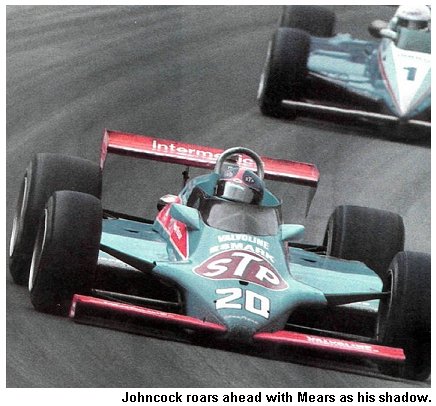
The finish of the $1.6 million race, the 66th Indy classic, was an emotional tug of war for the more than 300,000 people on hand as Mears all but erased a 12-second deficit over the last 13 laps, finishing just .16-second behind Johncock.
The closest previous Indy race was a 2.16-second victory by Wilbur Shaw over Ralph Hepburn in 1937. Last year's was the second closest, with Bobby Unser beating Mario Andretti, Johncock's teammate, by 5.2 seconds.
The race was the second-fastest in Indy history. Johncock, 45, from Coldwater, Mich., averaged 162.029 mph, just shy of the record of 162.962 set by the late Mark Donohue in 1972. Mears averaged 162.026. Elapsed time for the race was 3 hours, 5 minutes, 9.14 seconds.
Johncock won the 1973 Indy race, but never was given much credit for it. That race was shortened by rain, and run under the spectre of a crash at the start, two days of rainouts and two deaths.
"This surely was a lot different than the other win in '73," said Johncock, who will collect about $300,000 for the victory. "That was in the rain in pit lane, when they decided not to run anymore. I'll never forget this one."
This race began on a discordant note, with a multicar accident on the pace lap eliminating the cars of 1969 winner Andretti, Mears' teammate Kevin Cogan and two other drivers, and holding up the start for nearly an hour.
Mears, who set a qualifying record of 207.004 mph in pacing the fastest Indy field ever, was the solid favorite at the start and appeared to take command several times during the race.
There were early challenges for Mears from four-time winner A.J. Foyt, competing in his 25th Indy, who went out halfway through the race with mechanical problems, and Tom Sneva. But the race turned into a tense duel between Johncock and 1979 winner, Mears.
The crowd went wild as Mears, racing at laps clocked over 198 mph, began to cut Johncock's big lead near the end. He chopped the margin to 10.5 seconds with 10 laps to go; five seconds with five laps to go, then three seconds, 1.6 seconds, a half second. Finally at the start of the last 2 1/2-mile lap, they were wheel-to-wheel.
But Johncock never let Mears get the nose of his Penske PC10 ahead of his own red and blue Wildcat-Cosworth. At the finish, Johncock dove his racer low on the main straightaway to keep Mears from getting by.
"I was trying everything I could think of, but he had a lot better straightaway speed,” Mears said, I could catch him in the corners, but I couldn't hold it."
A bumping incident in the pits with 17 laps to go probably cost Mears the victory. He was making his final scheduled stop when he ran into the back of the slow-moving car of rookie Herm Johnson.
 "I
couldn't get around him," Mears explained. "I hit him and lifted him off
the ground. That put us too far behind to catch Johncock." Mears' final
pit stop lasted 20 seconds, seven seconds longer than the last stop for
Johncock.
"I
couldn't get around him," Mears explained. "I hit him and lifted him off
the ground. That put us too far behind to catch Johncock." Mears' final
pit stop lasted 20 seconds, seven seconds longer than the last stop for
Johncock.
Pancho Carter was third, followed by Sneva and three-time winner Al Unser. Another three-time winner, Johnny Rutherford was eighth. Standings are not official until they are posted Monday morning.
The race also was marked by one fire incident and at least two instances of spilled fuel despite new safety rules for handling the volatile methanol.
Johncock make his last pit stop three laps after Mears, getting in and out of the pits smoothly as the crew of car owner, U.S. "Pat" Patrick rose to the occasion. The STP-sponsored car drove back onto the track nearly one third of a lap ahead of Mears.
The first attempt to start the race ended abruptly with a pair of accidents that eliminated four starters, including 1969 Indy champion Mario Andretti, Johncock's teammate driving an identical car, and Mears' swift teammate, Kevin Cogan.
The 26-year-old Cogan, in his second Indy, suddenly slid sideways from his starting spot in the middle of the front row, just ahead of Johncock, who managed to get past unscathed.
He said he wasn't sure what happened, but several veterans speculated that Cogan was in too low a gear because of an unusually slow pace prior to the accident.
"The pace was way too slow," said three-time Indy winner Johnny Rutherford, who was several rows behind Cogan. "Cogan was in low gear. When they let us go, he leaped on the throttle and the car just jumped and let go."
Cogan slid into A.J. Foyt, on the outside of the front row, and bounced off directly into Andretti, who was in the second row. Andretti came off Cogan and slammed into the inside wall.
Meanwhile, Dale Whittington and Roger Mears, two of the Indy rookies in the starting field, tangled back in the pack. Mears, Rick's older brother, slowed and Whittington, the youngest of the first trio of brothers to start here, spun into him, taking out both cars.
Andretti, who was embroiled in a post-race rules controversy last year, said he was "never more disappointed in my whole life. It shouldn't have happened. It looked like Cogan was just looking for trouble."
Roger McCluskey, competition director for the sanctioning U.S. Auto Club, agreed with Rutherford and others the pace was too slow before the accident, but added, "Mears, as the man on the pole, is in control of the pace. He can set it wherever he feels it is right."
The cars had not crossed the starting line when Cogan started the chain reaction, so the green flag did not come out. The rest of the field was brought into the pits, the crews were allowed to add four gallons of methanol fuel to their pit tanks to replace what they had used of their 280-gallon limit in the three warmup laps. The field was reformed and took the green flag about 50-minutes later.
The official start was ragged, with the field spread out unevenly, but it was uneventful. Foyt, who had a left front wheel support replaced and the front end of his car realigned during the break, jumped past Rick Mears into the lead as the 29 remaining cars dived for the first turn.
The first car out due to mechanical problems was the March-Cosworth of Mexico's Josele Garza, the 1981 Indy rookie of the year, who went out on the first lap with an oil leak.
Both Bill Whittington and rookie Hector Rebacque of Mexico were hit with two-lap penalties for illegal passing under the yellow.
Tony Bettenhausen, the younger of two brothers in the race, brought out the first yellow caution flag of the race on lap 39. Something apparently broke in his March-Cosworth and Bettenhausen suddenly spun into the outside concrete wall on the main straightaway. There were no other cars involved and Bettenhausen was not injured.
Another crash brought out the second yellow. Danny Ongais, who was badly injured in a third-turn accident a year earlier, lost control in the second turn, bounced off the outside wall and spun into the infield grass. Rookie Chet Fillip slowed to avoid the wreckage and Jerry Sneva, younger brother of Tom Sneva, tangled with Fillip, sending them both into the infield and out of-the race. There were no injuries.
Foyt, a big favorite of the crowd of more than 300,000 people, dominated the first 50 laps of the race, but slipped back after going through a fuel problem on a pair of pits stops during the second caution period.
The valve on Foyt's fuel hose stuck open on the first stop and the highly combustible fuel was sloshed over the car and into the cockpit, bringing back vivid memories of a pit fire in 1981 in which Mears suffered facial burns and two of his crewmen were badly burned.
The heat from Foyt's car did not ignite the fuel, however, and he quickly left the pits. His crew fixed the valved and Foyt ducked in again to get the 40-gallon on-board tank refilled the next time around. But he was in eighth place when the green flag was dropped on lap 72.
Foyt, 47, later had severe problems with the gearbox in his March-Cosworth, one of 17 such cars in the 33-car lineup. He retired the car on lap 100, exactly halfway through the race.
There were six leaders, including Mears, Tom Sneva, Foyt, Johncock, Ongais and Don Whittington, before Mears passed Johncock at the start/finish line on lap 109. Sneva also passed Johncock, who slowed briefly.
The rest of the way was a battle among Mears, Sneva and Johncock, slowed only by a series of caution periods.
There were several blown engines, a harmless spin by Johnny Parsons and a fourth turn crash by rookie Danny Sullivan. Johncock also was splashed with fuel in the pits and Rebacque was eliminated from the race by a fire in the pits, but it appeared nobody was burned.
The race was run under the cloud of Gordon Smiley's death in a brutal accident during the first weekend of time trials, the first fatality at Indianapolis in nine years. However, despite several accidents, there were no injuries reported.
|
|
|
|
|
|


RETURN
