
*From Wikipedia
|
The State of Kansas and the NCAA Tournament
|
 |
|
|
I grew up in Kansas. It was a basketball state. Like Kentucky, North Carolina and Indiana, the game has always captivated the citizens of the state. Kansas has always held a special place in the history of college basketball. James Naismith, the founder of the game, was the first basketball coach at the University of Kansas.
The state has witnessed great players and coaches through its history. The immortal coaching names spawned from the Kansas prairie go on and on: Phog Allen, Adolph Rupp, Dean Smith, Ralph Miller, Eddie Sutton, Jack Hartman, Tex Winter, Gene Keady and Jack Gardner. There were a few other coaching legends that passed our way through the years: Larry Brown, Roy Williams, Cotton Fitzsimmons, Eddie Fogler, Bill Self and Ted Owens. Players have dribbled and slammed their ways through the annals of history: Lucius Allen, Rolando Blackman, Bob Boozer, Antoine Carr, Wilt Chamberlain, Kirk Hinrich, Lon Kruger, Clyde Lovellette, Danny Manning, Xavier McDaniel, Paul Pierce, Mario Chalmers, Darnell Valentine and JoJo White.
The NCAA Tournament was organized in 1939 and was largely inspired by Kansas Coach Phog Allen. The history of the NCAA Tournament has been heavily influenced by the three primary institutions of Kansas: Kansas University, Kansas State University and Wichita State University. There have been 74 NCAA Tournaments since 1939 and Kansas schools have represented the state in 20 Final Fours. That�s more than once every four years. March Madness hits Kansas like a tornado.
These pages are devoted to those Final Four teams and heroes. It also pays tribute to a few near misses that brought fans to the edge of their seats and fostered many "what might have been" discussions through the years. It is not specifically about KU basketball, as the title may lead readers to believe. It is about the three Kansas basketball powers, their great players and their contributions to the history of the sport.
1940- In the tournament�s infancy, Kansas and Indiana meet for the title.
1948- The tourney favorite, KSU, is upset by scrappy Baylor in the Final Four.
1951- It�s Wildcat vs. Wildcat for the national title.
1952- It�s Phog Allen�s finest moment as KU takes the title.
1953- KU fails to defend its title by a single point.
1957- It�s Wilt Chamberlain against the rest of the nation as Kansas advances to the title game.
1958- K-State gets by Oscar Robertson, but can�t duplicate the feat against Elgin Baylor in the Final Four.
1964- It�s Wildcats vs. Shockers for a trip to the Final Four.
1965- A Final Four season for Dave Stallworth and WSU, but all they remember is Bill Bradley.
1966- Ted Owens� Jayhawks were the biggest obstacle on Glory Road.
1971- Hawks make a serious challenge to the UCLA Dynasty.
1974- Upstart Oral Roberts expected a miracle, but Kansas got it and a trip to the Final Four.
1975- Kansas State almost blows up the East.
1982- A Kansas showdown in New Orleans and Hartman�s magic upsets the West.
1986- The Hawks fight back to the Final Four after 12 years, but are stopped by Duke.
1988- Danny Manning and Larry Brown take the Kansas program back to the mountain top.
1991- Monster program after monster program are vanquished on the way to the title game.
1993- The old master, Dean Smith, defines true greatness for Roy Williams and the Fab Five.
2002- One hell of a run to the Final Four, but it was Gary Williams� and Maryland�s Year.
2003- One game closer to the summit, but a collision with Carmelo.
2006- Wichita returns to respectability, but George Mason wears the glass slipper.
2008- Near misses in '53, '57, '66, '91 and '03 couldn�t be erased with one shot, but Mario Chalmers came damn close.
2011- Wichita State dominates the NIT.
2012- Two Legendary Programs Meet for the Title.
2013- The Shocks play angry and return to the Final Four.
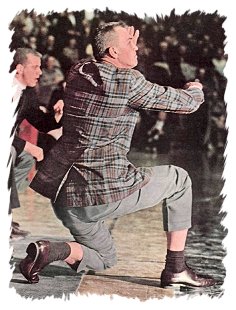
Wichita's Ralph Miller, 1964
Format history
The NCAA tournament has expanded a number of times in the last 65 seasons. This is a breakdown of the history of the tournament format:
Prior to 1975, only one team per conference could be in the NCAA tournament. However, a few factors led the NCAA to expand the field, notably the 1971 season when USC was #2 in the country with only 2 losses (both to #1 UCLA), and the 1974 ACC basketball Tournament final between Maryland and NC State, both of whom were top 5 teams that year.
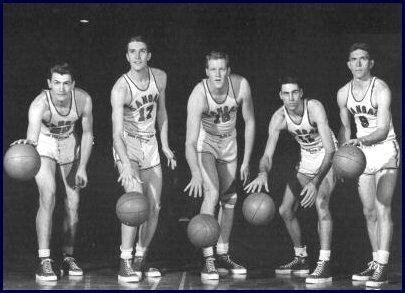
These pages are dedicated to the memory of Mr. John Keller. John was a member of the 1952 Kansas University national championship team, a member of the gold medal winning USA Olympic Basketball Team of 1952, a high school and junior high basketball coach and a teacher. As far as importance, those who knew John know that the order is reversed. He was, above all, a teacher of children. He taught this author to drive as a teen and supported me as I became the minister of our church as an adult. John was a respectful and unassuming guy. He was the person in our church who delivered the tapes of the services each week to the shut-ins throughout the community. That's the kind of man he was. He remains an inspiration to those who had the privilege of knowing him. For John's friends, I have chosen shots of that 1952 season that feature him where possible.
KU 1952 Starters. John Keller is far left. |
|
|
|
