|
First Round
By Harold
Bechard
The Salina (KS)
Journal
  CHICAGO-
You'll have a tough time convincing Ball State coach Dick Hunsaker that
Kansas had been mired in a shooting slump. But, the fact is this: The
Jayhawks hadn't hit better than 50 percent from the field since Jan. 30-
a span of 12 games. CHICAGO-
You'll have a tough time convincing Ball State coach Dick Hunsaker that
Kansas had been mired in a shooting slump. But, the fact is this: The
Jayhawks hadn't hit better than 50 percent from the field since Jan. 30-
a span of 12 games.
The
Jayhawks took care of that bit of trivia in a big way Thursday afternoon
with a dynamite shooting display that finally subdued the upset minded
Cardinals in the first round of the Midwest Regional.
Kansas
hit 56 percent from the field and outscored Ball State by 20 points in
the final 13 minutes to roll to a 94-72 victory at the Rosemont Horizon.
The
victory boosted the Jayhawks (26-6) into Saturday's 3:30 p.m. second
round game against Brigham Young.
Ball
State (26-8) ended its season after giving Kansas all it could handle
for much of Thursday's game. The Cardinals, despite missing nine of
their last 10 shots, hit 53 percent from the field to stay dangerously
close to KU until the final minutes.
"For
thirty minutes, we played as well as we could possibly play," Hunsaker
said. "We played them tooth and nail."
In the
end, however, two things buried the Mid-American Conference
co-champions- KU's depth and accurate shooting.
The
Jayhawks had nine players play 12 minutes or more and two others combine
for 16 more. Although the two benches each scored 22 points, Ball State
lost its legs and shooting touch in the final 10 minutes.
"They
actually become more athletic when they go to the bench," Hunsaker said
of KU. "We just never could quite get the lead and that's what you need
to do as a huge underdog."
The
Cardinals came close to taking the lead on several occasions, but each
time, a KU player stepped up and buried a jump shot.
No one
was bigger than KU guard Rex Walters. The 6-4 senior, who was back in
the city where he spent two years at Northwestern (1988-90), tied an
NCAA Tournament record by hitting six straight 3-pointers. He finished
with 23 points, five assists and four rebounds.
"Rex
was sensational," KU coach Roy Williams said. Walters wasn't alone.
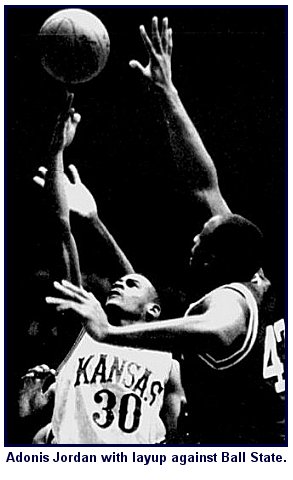 �
Backcourt-mate Adonis Jordan produced a double-double- 13 points and 11
assists- as well as four steals after scoring just three points in the
first half. �
Backcourt-mate Adonis Jordan produced a double-double- 13 points and 11
assists- as well as four steals after scoring just three points in the
first half.
�
Senior center Eric Pauley, playing with an injured left knee, hit 9 of
13 shots- five of them beyond 15 feet-
to finish with 18 points.
�
Junior forward Richard Scott, a player Hunsaker called "the most
underrated player in America," scored 16 points and grabbed four boards.
�
Steve Woodberry came off the bench and finished with 10 points, but had
a part in three of the game's biggest plays.
�
Sophomore center Greg Ostertag, needed because of second half foul
trouble to Pauley, came through with eight points, four rebounds and two
blocked shots in 14 minutes.
All in
all, it was a game to savor for Kansas. Not only did the Jayhawks win,
but they looked good doing it.
"They
played well and we had to play very well to beat them," Williams said of
Ball State. "It was a challenge for us because everyone has been putting
us in the grave. The kids and coaches got tired of it."
And
Hunsaker's worst fears were realized as KU took its frustration out on
his team.
"We
have been playing great basketball for seven weeks now, as fine as Ball
State has played since I've been here," Hunsaker said. "Kansas,
conversly, had not been playing extremely well and everyone had been
talking about how poorly they have been playing."
"But,
it's kind of like telling (super model) Christie Brinkley she's losing
it. That's just not the case."
Although Kansas never trailed after a 3-pointer by Walters at the 15:12
mark of the first half, the Jayhawks never shook the Cardinals until 25
minutes later.
With
both teams hitting high percentages in the first half- KU 60 percent and
Ball State 58 percent- Kansas never opened up more than a nine-point
lead during the middle part of the game.
But
the Cardinals never overtook KU, either. Ball State cut KU's lead to one
point five times, two points on five more occasions and three points
three other times, but never got over the hump.

Second Round
By
Harold Bechard
The
Salina (KS) Journal
CHICAGO- The Kansas Jayhawks are back in the NCAA Tournament's
"Sweet
16" because of the sweet stroke of Rex Walters. Walters, proving that
Chicago is his kind of town, scored a career-high 28 points on Saturday
to propel the Jayhawks to a 90-76 victory over Brigham Young in the
Midwest Regional.
The
victory advances the Jayhawks into the third round of the NCAA
Tournament for the sixth time in 12 years where they will meet the
surprising California Bears, a stunning upset winner over two-time
defending national champion Duke.
The
Jayhawks and Bears will square off Thursday night in the regional
semifinals in St. Louis. But first things first. The victory wipes out
the bitter memories of last year's devastating second-round loss to
Texas-El Paso.
Well,
almost.
"This
right here has taken a big load off our shoulders," KU head coach Roy
Williams said.
But,
just like two days earlier against Ball State, the final score doesn't
tell the whole story. Kansas (27-6) used a 23-4 run in the final four
minutes to break open what looked to be a game that would go down to the
wire.
The
Jayhawks trailed by one point (68-67) with 4:38 remaining in the game
when they quickly destroyed the upset hopes of the Cougars from the
Western Athletic Conference.
Adonis
Jordan and Steve Woodberry took turns burying 3-point shots to start a
10-0 run and the Jayhawks followed that up with a 9-0 run a short time
later to put the game away.
But
while Jordan and Woodberry provided the spark, Walters lit the fire. The
6-4 senior hit 9 of 15 shots from the field and all eight of his free
throws to eclipse his career-high scoring mark by one point. He added
six rebounds and as many assists in a dazzling 30-minute performance in
front of the sellout crowd of 17,463 in the Rosemont Horizon.
While
Walters was the main story on his first trip back to Chicago since his
days at Northwestern, he had plenty of help.
�
Woodberry, with ice water in his veins, came off the bench to hit one of
the game's biggest 3-pointers and finish with 14 points.
�
Patrick Richey joined the heroics with 22 quality minutes off the bench,
scoring 13 points and grabbing four rebounds.
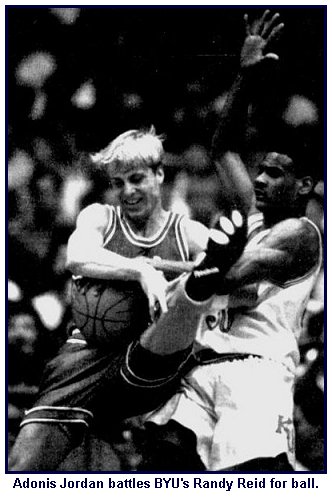 �
Jordan, who hit the game's biggest trey, finished with 13 points, five
assists and three steals. �
Jordan, who hit the game's biggest trey, finished with 13 points, five
assists and three steals.
� Eric
Pauley helped keep KU on top in early with 11 of his 12 points in the
first half and also finished with seven rebounds and four steals.
And
don't forget the Jayhawks' free throw shooting. KU went head-to-head
with one of the nation's best free throw shooting teams and didn't
blink, hitting 27 of 34 in the game.
"The
strongest part about Kansas basketball is if you're down, someone will
be in there to pick you up," Williams said. "And we had plenty of guys
do the job today."
The
well went dry for the Cougars just when it looked like the WAC would
send the Jayhawks home packing for the second straight year in the
second round.
With
6-4 senior Nick Sanderson burying one 3-pointer after another and the
Cougars using their size inside, BYU stayed with Kansas for 36 minutes
and never lost contact despite trailing by 10 points (45-35) at
halftime.
A 9-0
run by the Cougars in three minutes knotted the game at 60-60 with 9:31
remaining. The Cougars (25-9) then took a 68-67 lead with 4:38
remaining after a pair of free throws by guard Randy Reid.
"We
were right where we wanted to be," BYU coach Roger Reid said.
That
turned around as quickly as Jordan could bury a 3-pointer from the top
of the key to give KU a 70-68 lead with 4:11 remaining.
After
a miss by Sanderson, who had six 3-pointers in the game and a team-high
24 points, Woodberry drained a trey from deep in the corner to put the
Jayhawks up by five.
Brigham Young's Jared Miller was then called for a offensive foul at the
2:55 mark, which led to a pair of free throws by Richey. Richey then
added two more free throws 14 seconds later after another miss by
Sanderson and the Jayhawks were on their way.
"We
were trying to get the ball to certain people, but ultimately, we didn't
get the shot we wanted," Reid said. "A critical call during that time
was when Jared Miller was charged with an offensive foul.''
Walters then polished off his performance with an offensive rebound and
free throw and a breakaway slam dunk as Kansas led by as many as 18
points in the final minute.
"We
just let it slip away," Reid said. "Their defensive pressure was too
much for us."
Kansas
forced BYU into 21 turnovers and the Cougars, who had hit 12 of their
first 17 shots in the second half, missed six in a row during KU's final
dash to the finish line.
"We
were a little fresher and it looked like we just wore them down,"
Williams said. "And I thought we caused them some problems with our
half-court pressure."
Sanderson led BYU with 24 points and Miller added 13.

Regional
Semifinal
 ST.
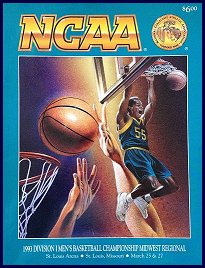
LOUIS (AP)- Hot-shooting Rex Walters outplayed freshman sensation Jason
Kidd on Thursday night and helped Kansas end California's golden trip
through the NCAA Tournament (video). ST.
LOUIS (AP)- Hot-shooting Rex Walters outplayed freshman sensation Jason
Kidd on Thursday night and helped Kansas end California's golden trip
through the NCAA Tournament (video).
Walters scored 24 points and was 4-for-5 from three-point range as
second-seeded Kansas beat sixth-seeded Cal 93-76. Kansas hit eight of 11
three-point attempts overall. The Jayhawks (28-6) will play top-seeded
Indiana (31-3) in the regional final Saturday night.
Walters, who made eight of nine shots overall, has saved his best for
the tournament. He's averaging 14.2 points, but he had 23 points in the
first round against Ball State, then 28 against Brigham Young. In the
three games he's a combined 24-for-33 from the field, including 12-of-17
from three-point range.
Adonis
Jordan added 15 points and Steve Woodberry had 13- all in the second
half- for Kansas.
That
was enough to stop California (21-9), which had been 11-1 since
29-year-old Todd Bozeman was named coach on Feb. 8, including victories
over LSU and two time defending NCAA champion Duke in the tournament.
Kidd
did his best to put the Golden Bears into high gear with his up tempo
play. Despite frequent double-teaming, he finished with 13 points, 11
assists and four turnovers before fouling out with 1 minute, 21 seconds
to play. That effort came close to his first two tournament games. His
last-second layup beat LSU 66-64 and he had 14 assists against Duke.
Kansas
trailed 52-48 with 15:38 to play before putting away California with a
22-6 run. Walters ended a streak of nine consecutive points with a
three-pointer and two free throws to make it 59-52, then the Jayhawks
took advantage of a 2-for-12 shooting slump by California to pull away.
Kansas
hit 19 of 22 free throws in the final 15:38 and finished the game 21 for
25.
Walters hit a driving shot off the glass with 2.2 seconds left and
completed a three-point play to give Kansas a 43-40 lead at the half.

Regional Final
By
Linda Robertson
Knight-Ridder Newspapers
 ST.
LOUIS- Kansas coach Roy Williams, a four-mile-a-day jogger, coaches
basketball games as if his players are running a marathon- at a steady
and unspectacular pace that is as relentless as a metronome. ST.
LOUIS- Kansas coach Roy Williams, a four-mile-a-day jogger, coaches
basketball games as if his players are running a marathon- at a steady
and unspectacular pace that is as relentless as a metronome.
Saturday, every time Indiana's Calbert Cheaney bent over to catch his
breath, he saw another wave of Kansas subs coming in, their lungs clean,
legs fresh.
Kansas
wore down Indiana like water on a stone to win the NCAA Midwest
Regional. 83-77, and advance to the Final Four in New Orleans.
"They
kept running in three or four guys every five or six minutes," said
Cheaney, who ended his brilliant college career without an NCAA
championship.
"Every
time I came off a screen, they had somebody waiting for me. So we set
double screens, and they still had somebody waiting for me."
Williams will go to his second Final Four in just five years as a head
coach; to play the winner of today's North Carolina-Cincinnati game. If
North Carolina wins, Williams will play against mentor Dean Smith.
"We
haven't exactly been the favorite, but we're a poised team," said
Williams, who spit into the Mississippi River for good luck before his
two games at St. Louis Arena. "Thank goodness the Mississippi runs all
the way down to New Orleans. We'll try it again down there."
Williams is 3-0 against Indiana coach Bob Knight, who was denied a sixth
trip to the Final Four with a No. 1 ranked team many thought would bring
him a fourth national championship.
But a
late-season knee injury to center Alan Henderson finally caught up to
Indiana.
Although Knight was gracious in saying Henderson's absence "made no
difference," Indiana was outmanned inside. Matt Nover, the Hoosiers' one
true post players, was held to nine points- two in the second half.
Forward Brian Evans, playing with a broken thumb, scored 10.
Kansas� four rotating front-liners scored 47.
"We
made a concentrated effort to get it inside," Williams said. "Without
Henderson- which is such a tragedy- we were stronger and taller inside."
Indiana led on only three possessions. Kansas fought off two Indiana
surges in the last five minutes.
"Their
defense was exceptional." Knight said. "Mostly what we did was hang in.
Their depth is part of their strength. We've got to score 80 against a
team like Kansas."
It was
the fourth straight game in which five Kansas players scored in double
figures.
Indiana had to rely heavily on Cheaney and Greg Graham, who combined for
45 points. Graham was burdened by four fouls late in the game. Cheaney
did not get a minute's rest, and Kansas used three different players to
scramble through Indiana's minefield of picks to keep up with him.
"We
wanted to keep giving Calbert different looks," Williams said. "We
started with Richard Scott and told him he'd have to shadow Calbert.
Then we put Darrin Hancock and Steve Woodberry on him. And they're our
two best perimeter defenders."
Kansas
led by as many as eight points in the second half, but Graham's driving
layup with 1:36 left narrowed the gap to 76-73.
Kansas
countered with a lightning fast-break layup from Rex Walters to Adonis
Jordan.
"That
was a tremendously alert play when Walters drove down the sideline for
the quick basket." Knight said.
On the
next play. Indiana's hopes sank further when Cheaney and Evans missed
jumpers and Eric Pauley swatted away a third Indiana attempt. Walters
sank both ends of a one-arid-one free-throw opportunity with 51 seconds
left for an 80-73 lead.
"Our
guards made great plays down the stretch," Williams said. "I've always
said I wouldn't trade Jordan, Walters and Woodberry for anybody in the
country."
A
layup by Kansas' smallest sub, Calvin Rayford, gave the Jayhawks their
biggest lead, 58-50, at the 11:22 mark (video).
After
two Kansas turnovers, including a bad alley-oop pass by Jordan that had
Williams laughing with clenched teeth, a Cheaney fall-away brought
Indiana to within four points.
But
Kansas kept coming up with more body blows. While five Indiana players
logged 27 minutes or more. Kansas spread the workload among 11 with only
Jordan playing more than 30 minutes.
A
Damon Bailey follow concluded a 10-2 Indiana run that put the Hoosiers
ahead 48-46 with 14:10 to go.
In the
first half, Kansas established its inside game early, getting 11 of its
initial 15 points from the front line en route to an eight-point lead.
After
a Jordan three-pointer gave the Jayhawks a 28-20 edge at the
seven-minute mark, the Hoosiers countered with an 11-2 run that put them
ahead for the first time, 31-30, with 3:07 left. Cheaney scored six
during the rally.
National
Semifinal
 NEW
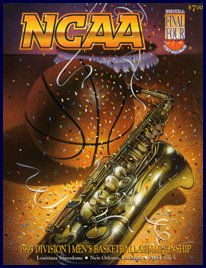
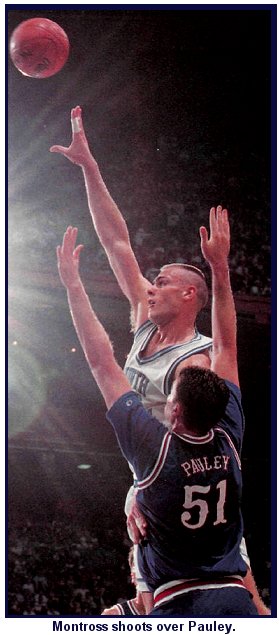
ORLEANS (AP)- Eric Montross, North Carolina's mountainous Mr. Inside,
and Donald Williams, the slick shooting Mr, Outside, took turns
pummeling Kansas. NEW
ORLEANS (AP)- Eric Montross, North Carolina's mountainous Mr. Inside,
and Donald Williams, the slick shooting Mr, Outside, took turns
pummeling Kansas.
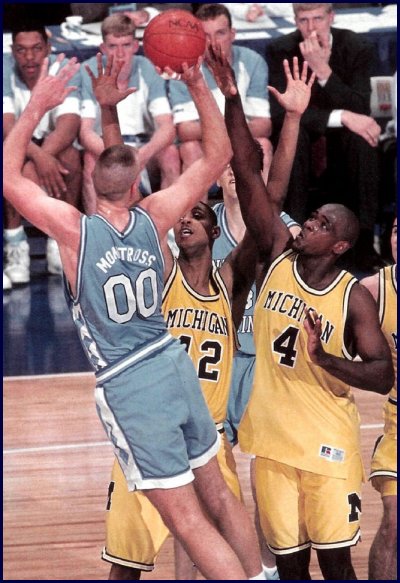
Montross dunked, Williams popped a 3-pointer. Montross flicked in a
soft, short hook, Williams tossed up another 3-pointer. They were like a
quick jab and a roundhouse right coming at Kansas all Saturday night,
and after a 78-68 victory in the Final Four the Tar Heels are back in
the championship game in the same Superdome where last they won the NCAA
title in 1982.
Clawed
and bleeding, wrapped in tape on his fingers and shin, Montross flexed
his muscles and shook off pesky Kansas from start to finish.
The
7-footer was unstoppable under the backboards, scoring 23 points and
clogging the middle on defense, while Williams surpassed him from the
outside with 25 after hitting five 3-pointers in seven attempts.
"We
needed Donald Williams' outside shooting and he really came through,"
North Carolina coach Dean Smith said. "And our big people did a great
job on their big people."
North
Carolina led virtually from the start, yet every time the Tar Heels
seemed on the brink of breaking open the game, Kansas shot its way back
behind Adonis Jordan and Rex Walters' 19 points apiece. Kansas' starting
front line accounted for a total of only 15 points.
"Their
whole team's a lot stronger," Walters said. "This is the second most
physical game we've played in all year. I haven't seen that much
strength in a team since we played Michigan. Physically, they put bodies
on you. Not their big guys only, but their guards, too."
"Whenever we'd make a run, whenever me or Adonis would make a three,
they'd come right back and get it inside. They just physically wore us
down."
Kansas
may have been worn down and beaten up, but the Jayhawks never quit in a
game that was thrilling throughout.
Only
in the final minute, when North Carolina pulled away 75-65 and Kansas
was forced to foul, did the victory seem certain for the Tar Heels.
This
was a brilliant matchup of styles, dictated more by the size and talents
of the players than the similarities between Smith and his former
assistant, Roy Williams of Kansas.
Montross inside and Williams outside scored 29 of North Carolina's 38
points in the second half, and there was nothing Kansas could do to
contain them.
 "Our
offense is basically go inside and hopefully open up the outside stuff,"
said forward George Lynch, who had 14 points and 10 rebounds. "Eric did
a great job of taking it to them, so there was no reason to go to any
other option." "Our
offense is basically go inside and hopefully open up the outside stuff,"
said forward George Lynch, who had 14 points and 10 rebounds. "Eric did
a great job of taking it to them, so there was no reason to go to any
other option."
North
Carolina (33-4) moved within a victory of repeating its run to the
championship here. In Smith's 32 years guiding the Tar Heels, they've
reached the Final Four nine times and the championship game five times.
The
victory evened Smith's friendly rivalry with Williams, whose Jayhawks
beat the Tar Heels in the NCAA semifinals in 1991 before falling to Duke
in the championship game.
"Two
years ago, we made the plays down the stretch and they didn't," Williams
said. "This time, it was just reversed. But besides the coaches and
players on that staff, there won't be anybody in the world rooting
harder for North Carolina Monday night than I will be."
Kansas
(29-7) last won the national title in 1988, but then went on three
years' probation for infractions before Williams took over the following
season. The Jayhawks' only other NCAA championship in nine Final Four
appearances came in 1952.
The
contrast this time couldn't have been clearer on offense: North
Carolina's size and inside strength against Kansas' outside shooting.
The Tar Heels out rebounded the Jayhawks 35-24.
From
the start, when Montross opened with a short jumper and Jordan responded
with a 3-pointer, the pattern was set.
Each
team showed off its similar trapping defenses, North Carolina more often
pressing from backcourt to basket, but on offense the teams went
separate ways.
Montross, who has quick, strong moves and an eye for assists, helped
North Carolina to a 12-6 lead. But outside shooting by Jordan and
Walters, who had 13 points in the first half with three 3-pointers in
five attempts, closed the gap to 21-20.
The
Tar Heels then went on a 9-0 run for a 30-20 lead, keyed again by
Montross and Lynch, who had four of his 10 first-half points during that
span.
Both
teams took aim from outside the 3-point line for the rest of the half,
Williams hitting for North Carolina, Walters for Kansas, and the
Jayhawks cut their deficit down to 40-36 with a long jumper at the
buzzer by Darrin Hancock.
"The
first 14, 15 minutes of the game, I didn't think our defensive intensity
was as good as it needed to be," Williams said. "But when we got it back
to four at halftime, I felt real good because we hadn't played our best
game by any means and we were only down by four."
But
the pattern continued in the second half, Montross tapping in an
offensive rebound in the opening seconds, Walters hitting his fourth
3-pointer. Each time Montross seemed to knock everyone away and put the
North Carolina in control- he scored eight of the Tar Heels' first 10
points in the second half- the resilient Jayhawks came back. Jordan hit
a 3-pointer, Scott a couple of rare Kansas layups, and suddenly Kansas
was down only 48-46.
Montross did it again, hitting two a short hook and a layup to help
North Carolina go ahead 54-46, but once more a 3-pointer by Jordan
started the Jayhawks back.
The
Jayhawks chased relentlessly, yet each time they came close Montross and
Williams kept North Carolina out front.

National
Championship Game
Sports
Illustrated
April
12, 1993
Alexander Wolff
 Know
this about what it's like to play against the Tar Heels of coach Dean
Smith and the University of North Carolina: Eventually you run out of
time. Eventually you run out of timeouts. Eventually the passing of the
years delivers Smith a brace of players so perfectly meant to play with
one another- and for him- that they bring to glorious life all the
precepts and rules and dicta of the Carolina way. Know
this about what it's like to play against the Tar Heels of coach Dean
Smith and the University of North Carolina: Eventually you run out of
time. Eventually you run out of timeouts. Eventually the passing of the
years delivers Smith a brace of players so perfectly meant to play with
one another- and for him- that they bring to glorious life all the
precepts and rules and dicta of the Carolina way.
To
secure his second NCAA title, with a 77-71 win over Michigan in New
Orleans on Monday night, Smith- Dean, Dean the Witch Doctor Mean- dipped
into his trusty gris-gris bag, just as he did in the same Louisiana
Superdome in 1982, when Fred Brown of Georgetown inexplicably threw a
pass to the Tar Heels' James Worthy and thus cast a long-tongued kid
named Michael Jordan in his now familiar role as hero. Once more,
nothing rational, no philosophy, no scheme, no system, to use the word
Smith so disdains but won't ever escape, can fully account for the
strange doings in a title game involving Carolina on the Bayou.
In the
final seconds, with the Tar Heels up two threadbare points and Michigan
holding the ball, the Wolverines' splendid sophomore Chris Webber
incurred a technical foul by calling a timeout his team didn't have. As
the Tar Heels celebrate their third NCAA crown, the Final Four's Most
Outstanding Player, Donald Williams- like Mike, a native North Carolinian
and a shooter of wondrous skill- and his teammates should use "laissez
les jump shots rouler" as their partying cry and give a nod of thanks to
the mambo kings and queens of black magic. The Superdome court may have
been manufactured in Michigan, but Monday night's baskets, through which
Williams seemed to toss the ball at will, were made in North Carolina.
You
can hear Smith now, in his contrarian twang: Donald needs to work on his
passing and defense. He's a shooter, just a small part of the team. And
Smith is right; was this not his most exquisitely assembled team? Its
foundation came to Chapel Hill three autumns ago as the class of '94,
the ballyhooed group of players- center Eric Montross, point guard
Derrick Phelps, small forward Brian Reese, power forward Clifford Rozier
and swingman Pat Sullivan- who were quickly forgotten when Michigan
brought in its Fab Five a year later. Smith's group benefited from
perfect subtraction (the malcontent Rozier transferred to Louisville
after one season) and perfect addition (Williams and his crystalline
jump shot arrived as Rozier left), while the perfect senior (the
indomitable George Lynch) stood fast. Like spackling compound, a passer
(Henrik R�dl) and a shot blocker (Kevin Salvadori) filled cracks and
provided cohesion.
There's an optimal balance between freedom and responsibility that those
who work with young people- teachers, parents and coaches alike- all
strive to find. With these Tar Heels, Smith locked in on that balance
and held fast to the coordinates. By late February the team's offensive
decision-making ability caught up with a soundness at the defensive end
that had carried it to that point. As Smith granted them more and more
license, the players kept reciprocating, showing an ever keener sense of
obligation. Smith would never admit it, for he flatly refuses to compare
his teams, but no other had so completely bought into what he teaches.
Cynics
might say that Smith, a man obsessed with minutiae, would especially
savor a victory secured on a technicality. But they would miss the truth
about this season's team, a group that allowed Smith to be more
malleable than ever. The North Carolina coach promulgated the most
recent of his rules last month, shortly after Phelps bruised his
tailbone during the ACC tournament. Like any coach, Smith was tempted to
hurry such an irreplaceable player back sooner than might have been
prudent. Instead he vowed that no one would talk him into playing Phelps
before the coach judged him ready. Certainly if a player was limping,
out he would come.
So
there was Phelps, seven minutes into the second half of the Tar Heels'
semifinal game against Kansas, taking a hard fall and landing on his
pelvis. After sitting out for 41 seconds, he came back in. Though
clearly favoring his side and grimacing with every step, he carried on
for more than a minute before Smith replaced him with senior Scott
Cherry, a plucky reserve who, nevertheless, is essentially a glorified
walk-on. No sooner had Phelps left than the Jayhawks' Adonis Jordan
picked Reese clean and sailed in for a layup. Shortly thereafter
Williams mishandled a pass from Cherry.
With
that, Smith turned to Reese, who is Phelps's roommate. "You know him
better than anybody," Smith said. "Can he play?"
 "He
can play," Reese replied, and one of Smith's rules met its exception.
Phelps checked back in, and North Carolina celebrated his return by
forcing a 45-second violation. The Jayhawks soon found themselves in
tears at the Final Four for the second time in three years, after they
lost 78-68. "He
can play," Reese replied, and one of Smith's rules met its exception.
Phelps checked back in, and North Carolina celebrated his return by
forcing a 45-second violation. The Jayhawks soon found themselves in
tears at the Final Four for the second time in three years, after they
lost 78-68.
A
North Carolina box score from this season is like a passage of
Hemingway: terse but eloquent and full of idiosyncrasy. Parse the final
box from the Kansas game and you'll find every hallmark of these Tar
Heels. The center gets the most shots (Montross took 14). The point
guard (Phelps) passes off for baskets (six times) twice as often as he
shoots (three). The power forward rebounds in double figures (Lynch
pulled down 10). And the team's shooting guard (Williams) takes the
three-point shots (he launched all seven of the Tar Heels' threes) and
makes them (five found bottom).
Monday
night's defeat of Michigan, on the other hand, seemed at first blush to
be the work not of any sentient hand, but of d�j� voodoo. Then again,
maybe it wasn't; maybe North Carolina caused Webber's gaffe. Early in
the second half, in what seemed to be a meaningless incident at the
time, Phelps and Lynch sandwiched the Wolverines' Jalen Rose, denying
him a simple inbounds pass from teammate Juwan Howard. To avoid a
five-second violation, Howard had to burn a timeout- the timeout that
Webber will forever wish had been there to call at the end.
The
title game lurched strangely to-and-fro, with numerous lead changes that
weren't swings of one or two points, but great tidal ebbs. North
Carolina by five. Michigan by 10. Then the Tar Heels back up by eight.
Then, with 4:31 left, the Wolverines led by four. That's when Williams
unspooled his fifth and final three-pointer (5 for 7 in the semis
followed by 5 for 7 in the final; some systems analyst- sorry, Dean-
must have fit him with a powder-blue silicon chip).
The
upperclassmen took over from there. Phelps, after a block by Lynch,
sailed in for the layup that pushed North Carolina ahead by a point.
Lynch himself then knocked in a short turnaround jumper to put the Tar
Heels up by three. Rose then fumbled the ball in traffic, and Williams
intercepted, leading to a thunderous dunk by Montross. When Ray Jackson
tossed in a jumper, Michigan called timeout, trailing 72-69. Forty-six
seconds remained. In the huddle the coaches reminded the Wolverines that
they had no timeouts left. "We thought we mentioned it," head coach
Steve Fisher said later. "Apparently we didn't make the point specific
enough."
Reese
made a gift of the ball to the Wolverines by stepping over the sideline
while receiving the ensuing inbounds pass, and Webber put back another
errant three-pointer by Rose. Thus when Sullivan stepped to the line
with 20 seconds to play, the Tar Heels led by only one point, 72-71.
"This is for the national championship, baby," said Michigan's Rob
Pelinka to Sullivan as he sighted the first of a one-and-one. The shot
dropped through.
The
second, however, kicked off to the left, where Webber picked it clean,
just in front of the North Carolina bench. As the rest of the players
retreated downcourt, Webber pivoted, and then clearly dragged his pivot
foot before dribbling. Every last Tar Heel player, coach and team
manager leaped high in protest when no whistle sounded. None could have
known that Webber would soon make amends for the referees' oversight.
Phelps
and Lynch dogged Webber up the sideline, and with 11 seconds remaining
he covered up, bringing his hands together, perpendicular to each other
and throwing the familiar glance at an official. Even before the
technical was called, the Tar Heel bench erupted again, for everyone on
it knew the Wolverines had already spent their last timeout and the
title was now Carolina's. "Why did it happen?" Fisher would say. "How
did it happen? Sometimes you get in the heat of the moment and things
happen that you just say, 'It can't happen.'" As Williams knocked down
both technical shots, and two more free throws after Michigan fouled on
the next possession, somewhere Fred Brown must have been laughing.
The
Wolverines had been lionhearts in beating Kentucky 81-78 in overtime to
reach the title game. They sank their foul shots, played floor-slapping
defense and scrapped back after trailing by four in the extra period.
All in all, throughout this tournament, they did more than any team
should be obliged to do to repudiate the poisonous lies about
"underachievement" that had lately achieved the status of conventional
wisdom. "It's a shame that Michigan will probably get some new label for
losing this game," said Sullivan. "They came this close to winning two
titles and being labeled a dynasty."
Deano,
too, came to Webber's defense. "I don't think that timeout necessarily
cost Michigan the game," he said. "We only had three team fouls at that
point, and we were going to keep fouling them to use up the clock." As
usual Smith had every angle covered, every possible trump card ready to
play.
The
coach can deny it all he wants, but there are certainly many constituent
systems to whatever it is North Carolina does. There is an honor system:
If you're dragging, you flash a clenched fist, the "tired signal," and
the coach will take you out. But because you have credited the team with
your honesty, the team rewards you, letting you return to the game
whenever you're ready; Smith merely tells you whom to replace.
There's a buddy system, too. Each Tar Heel is paired with another. When
Williams gives the tired signal, R�dl usually enters the lineup. When
Reese flashes the sign, Sullivan fills in. When Montross wants out,
Salvadori is sprinting to the scorer's table.
There
is also an electrical system of sorts- or there had been. Since the
three-pointer was introduced in 1986, good shooters had a green light to
shoot threes, those with a less deft touch had a yellow light (they
could shoot only under certain circumstances) and a few lived on Deano's
own Bourbon Street, in his red-light district. "'Red light, green
light' was making me more hesitant," says Reese, who was one of several
Tar Heels who went to Smith during the off-season and prevailed upon him
to scrap the rule. "This year there is no light, and the team is more
comfortable with its shots. Coach Smith knows that a team of juniors and
seniors isn't going to try anything wild."
Do all
these systems add up to some sort of supersystem? Ultimately none of
this is nearly as bloodless as the word system might suggest. It has
been well documented how Smith, during his fourth season as head coach,
returned to Chapel Hill from a loss at Wake Forest in 1965 to find that
he had been hung in effigy. In the following, decisive months- before he
had taken teams to Final Fours in four different decades- he found solace
in a book called Beyond Our Selves, given to him by his sister, Joan.
One chapter, "The Power of Helplessness," allowed him to turn a trick of
paradox: An individual could plumb his own depths for strength, so long
as he recognized that there were limits to what that strength could
accomplish. Hence North Carolina's pathological exaltation of the team
over the individual. (Hence, too, the intermittent revelations when Tar
Heels enter the NBA and we find ourselves wondering why we had never
seen the full breadth of their skill in Chapel Hill.)
Today
Smith practices a self-effacement so scrupulous that it calls attention
to itself. He's fastidious not only about remembering people's names but
at memorizing the details that go with them and then using those
recollections as a shield, to deflect any attention that might hunt him
down. Last week Smith was feted, along with the other Final Four
coaches, at a huge NCAA gala at which he was obliged to speak under
conditions- at the center of a cavernous hall, with no podium to hide
behind, literally in the spotlight- that made his discomfort palpable.
Sure enough Smith was soon pointing out someone at a back table, a woman
who had asked him for an autograph earlier in the evening, a Margaret
from Arkansas.
There
also abides in Smith much of the activist spirit that helped integrate
lunch counters and campaigned for a nuclear freeze- the man who, like
John Stuart Mill, believes that society is perfectible. The coach takes
after the public man, and thus his teams are the product of constant
refinement. This season the legend of his obsession with detail grew:
When Montross and Reese caught a slow elevator before the Tar Heels'
opening game in the ACC tournament and wound up a minute and 20 seconds
late for a team meeting, that's how much time elapsed in North
Carolina's next game before Smith sent them to the scorer's table to
check in. Yet for all the rigor Smith brings to the game, none of his
many rules is immutable. A Brian Reese can walk into his office and
change Smith's mind.
There
is also a part of Smith that repudiates secularism, that still holds
fast to Beyond Our Selves. One player who recognizes this is R�dl, who
suggests that the team's interdependency is well expressed in the
epistles of Paul in the New Testament, which speak of the body's many
parts. "You may not be equal in talent," says R�dl, "but everybody is
equal in the eyes of God, whether you're a good player or a bad player."
The coach is a sort of minister, vested with the duty to serve his ad
hoc flock. He must see that the better players play more, of course, and
remind players and press alike that differences in talent are matters
relevant to how we make our way in the world. But he must also see to it
that three years of investment in "how we do things at North Carolina"
bring one closer to a state of grace than a few months do. That's why
the senior walk-on adorns the cover of the media guide while the hotshot
freshman helps the managers lug equipment. That's why junior college
interlopers are not welcomed. And that's why, after Saturday's victory,
Smith said (as he almost always manages to say), "I thought Scott Cherry
really gave us a lift tonight."
In 32
seasons the Associated Press has never once named Smith its Coach of the
Year; that may be because it's altogether too worldly an award for the
struggle he goes through each season. Even on the podium he couldn't
stop coaching. He actually orchestrated the cutting down of the nets so
that the seniors, of course, went first. Smith himself severed the last
strand with a pair of gold scissors that had been engraved with UNC 1993
NATIONAL CHAMPIONS- a gift from a fan who had sent a similar pair in
'82. When the players returned to the locker room, someone had already
written on the chalkboard: CONGRATULATIONS! GREAT TEAM!! NO PRACTICE
TOMORROW.
No
wrinkle to insert. No weakness to work on. No detail to refine. How ever
will Dean spend the day?
 |